National day of action speeches, David Bateman

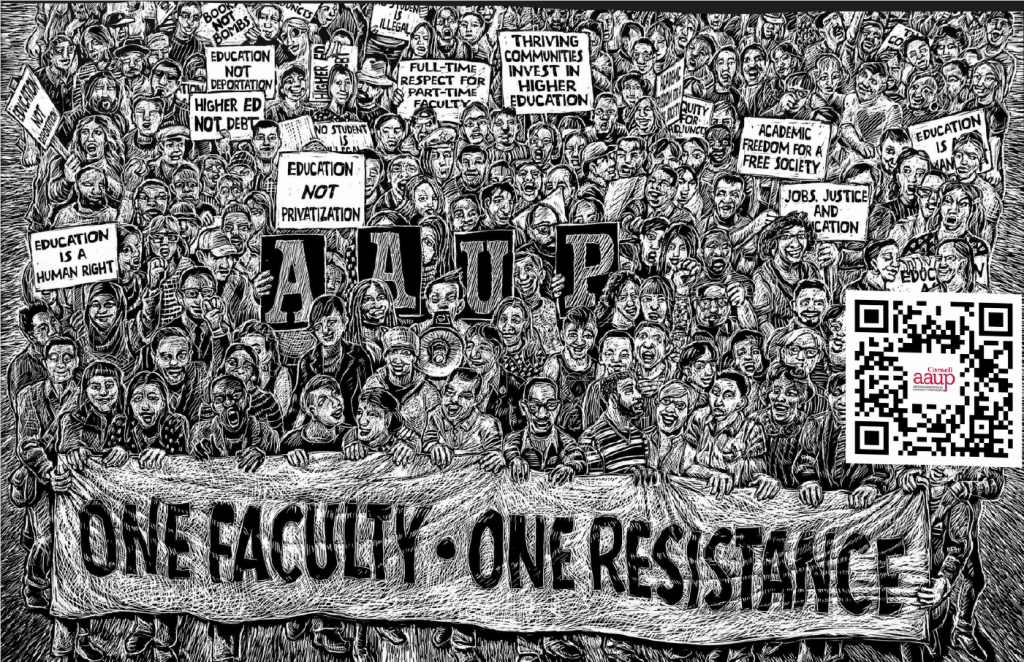
The April 17 National Day of Action had a great turnout at Cornell. We had speakers from across the university, in the sciences, humanities and social sciences, and the law school. We reprint some of these here.

I can’t tell you how heartening it is to see so many of you here today. And to know that we are just one of hundreds of rallies being held across the country as part of our national day of action.

In addition to being VP of the Cornell chapter of the AAUP, I’m also a political scientist who studies democratization and its reverse – the decline into authoritarianism. The attacks on higher education we’re seeing today are unprecedented in this country in their scope and severity. But they are not new. They are taken straight from the authoritarian playbook, from Russia, to Hungary, to Venezuela, to Turkey to Florida and now to the federal government. For many of our international colleagues, what they’re seeing now is terrifying but entirely familiar.  

Authoritarians have always targeted universities. Why? I often hear that it’s because an uneducated population is a compliant population. I don’t think that’s quite right. I think there are two fundamental reasons:

(1) Attacks on universities are part of a broader assault on civil society. Suing CBS or ABC because of their coverage, or threatening to strip them of their broadcast license; going after law firms that worked for causes you dislike; threatening to punish businesses and organizations that step out line. Authoritarianism cannot tolerate a robust and independent civil society.

In today’s competitive authoritarianism, where elections still happen, rigging the playing field of civil society is essential to securing authoritarian rule. Universities are part of that.

(2) the second reason is more fundamental. The pretext for attacking universities has changed – anti-communism, anti-DEI, anti-woke – but the goal has stayed the same: to frame the University as an anomalous space outside the mainstream of American life, a topsy-turvy inversion of social hierarchies, where people are supposedly promoted on the basis of DEI rather than merit, where faculty can’t be fired and in fact are supposed to govern, where students are free to pursue their interests, to disobey, with consequences for sure but with consequences calibrated to the idea that the university exists precisely in order to give students and researchers and teachers the freedom necessary to discover.

The authoritarian story about universities works to naturalize and justify social hierarchies by creating a fictional version of the university where these are inverted.

But it has this kernel of truth to it: The standards of excellence in a university are in many ways not the same as they are elsewhere. The standards are not how much money you make. They are not how well you convert knowledge into commercial applications. That might happen, might be encouraged, might be a good thing, but the goal is the knowledge first and foremost.

But it isn’t even the knowledge that is most threatening to authoritarians. It’s the practices and protections of academic freedom – the institutional guarantees that allow us to pursue understanding and knowledge and to merit them for their own sake – that are threatening to them. And like all bullies, they threaten in turn that which threatens them.

So what’s our strategy? How do we respond?

Well, first off we can only respond collectively. What’s the song say? “For what force on earth is weaker than the feeble strength of one?” The first step, the one we’re taking today, is to come together and stand together!

This is not going to be easy. We’re here today in force. But what about tomorrow, when the Trump administration says that it might restore funding if this program is axed, if these students are expelled and deported, if these courses are shut down?

We know their strategy. It’s to divide us, or to keep us divided. They count on us turning against each other – treating this program as expendable, this person as disposable. They target the sciences, hopeful the sciences will turn on the humanities or that the humanities will look the other way. They target international students in order to silence all students. They hope that tenured faculty will see untenured colleagues – staff, RTE faculty – fired and turn away.

One of the big lies of authoritarianism is that they will oppress one without oppressing the other; that they can cut out one person – the immigrant, the climate scientist, the transgendered student – and leave the rest intact.

But it’s a lie.

“Any person any study” might be a motto or a principle. But it’s also a basic truth: you are not really free to study at all if you are not free to study all and to go wherever your studies take you.

So in coming together today, let us pledge to each other that no part of the University is expendable. No person at the University is disposable.

Second: The resistance to authoritarianism is going to come from below. And it’s going to work in part by making it clear to our organizations and institutions that we will not accept rolling over. We need to give our leadership and our allies the courage of their convictions.

So I want to thank Mike Kotlikoff for joining two national lawsuits. As he put it, Cornell cannot compromise on its core mission, “to do the most good,” or its core values of “any person any study” and academic freedom.

I want to thank him for throwing our hat in the ring. But it’s also going to take a lot more than those two hats!

University leadership has talked about how they want other universities, public universities in red states for example, to take the lead, because the ivies are too unpopular. Now, when those universities were under attack, the ivies said, well it wouldn’t do them any good for us, who are so unpopular, to come out in their defense.

We can’t accept that. If we won’t lead, no one will. Harvard has now set an example. And that’s really got to burn. But they do so after making huge concessions already, when they realized that no amount of conceding would provide protection. That lesson needed to be learned, but as of now there is no excuse for not having learned it.  

Our leadership also includes the board of trustees. There’s been a lot of fear among the trustees, a belief that the university needs to get as close to Trump administration as possible, that doing so will protect us. But that’s not how this work. You cannot protect us by sacrificing who we are! You cannot save the University by demolishing it.

And our allies include New York State officials. Cornell is New York State’s public land grant college. It is one of its flagship institutions. It is state law that establishes the University Faculty at Cornell as the people responsible for setting education policy. It is state law that has established our majors and minors. It is state law that determines most of our diversity, equity, and inclusion policies. State law and authority are threatened by the federal assault on higher education and academic freedom. Cornell is one of the economic anchors of our region. And yet our state officials have so far been silent. They cannot be silent any longer.

Our potential allies include the Democratic Party in Congress. At some point the government will need to be funded – they should do everything in their power to demand a complete end of the assault on higher education and the reversal of those unlawful policies, as well as any stray lawful ones, that constitute this assault.

Finally – it is on us to hold the line. In our organizations, on campus and off; in our institutions of shared governance; in our committees; in our public and private advocacy.

When someone says, we’d better scrub our diversity, equity, and inclusion principles from the website. No. We hold the line.

When someone says, we should comply with this order, despite its being contrary to our values. No. We hold the line.

When the federal government sends its version of the demands it sent to Columbia or Harvard, demanding this or that program be dismantled or put under new leadership acceptable to the federal government. No. We hold the line.

That’s the strategy. We stand together in solidarity. We pledge to each other, that no part of the university is expendable, no person disposable. That we – and not would-be, and if we don’t stop them, will-be authoritarian bullies – determine the educational policy of the University. We support our leadership in fighting back, and push them to do more. We hold the line.

David Bateman is vice president of the Cornell chapter of the AAUP, and is an associate professor in the Government Department and in the Jeb E. Brooks School of Public Policy.
National day of action speeches, Sandra Babcock

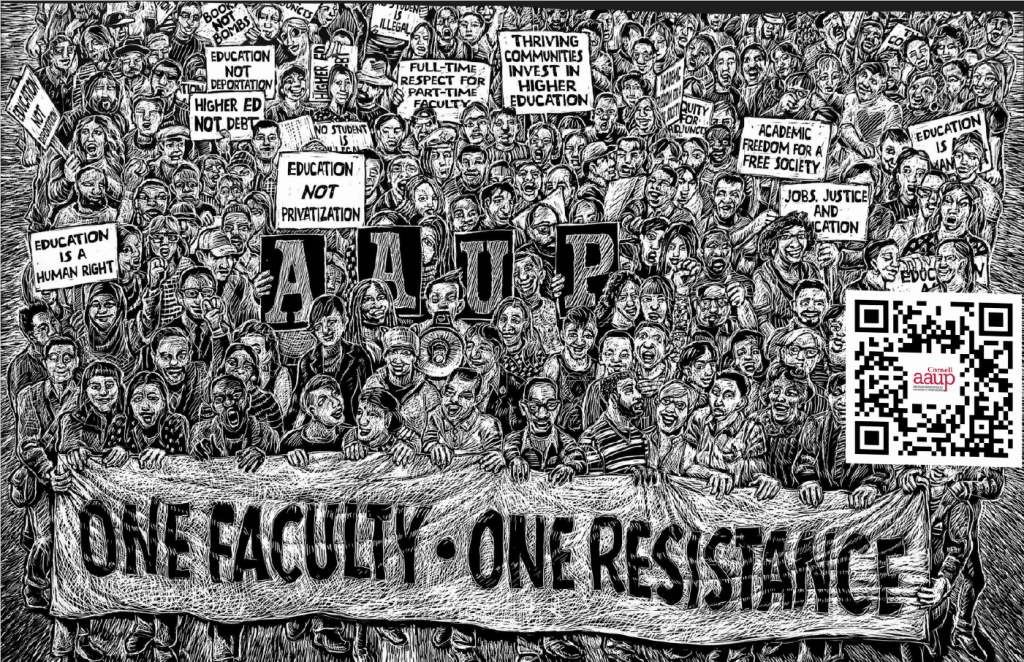
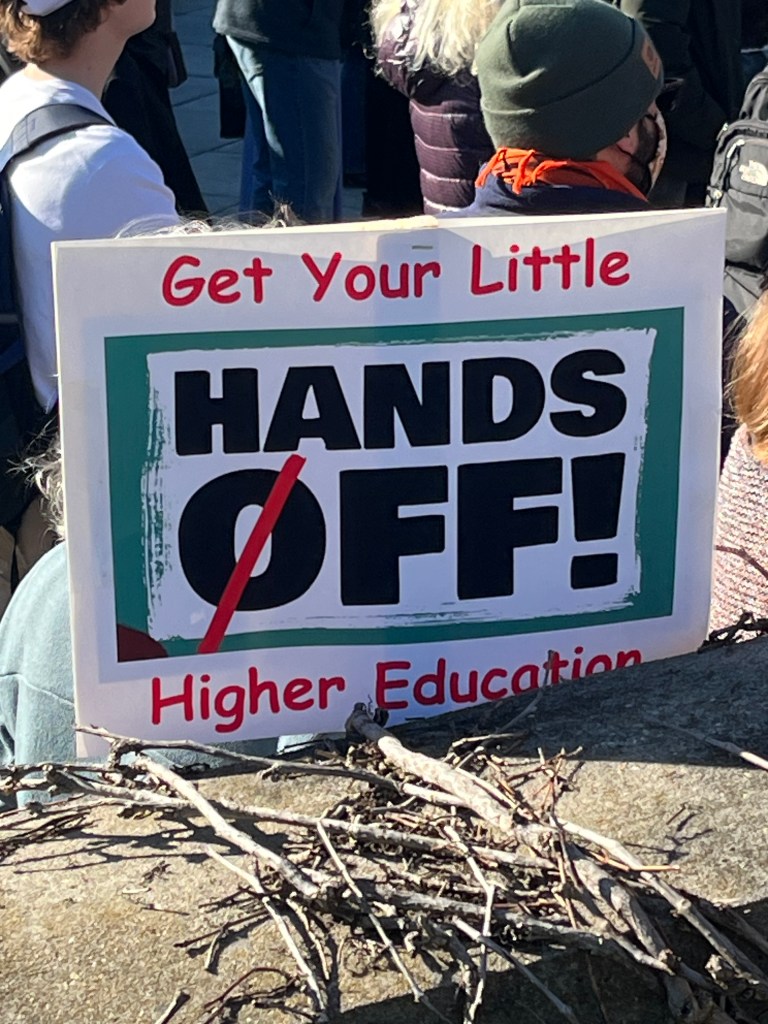
The April 17 National Day of Action had a great turnout at Cornell. We had speakers from across the university, in the sciences, humanities and social sciences, and the law school. We reprint some of these here.

This demonstration is a call to arms for the defense of higher education.

We are calling on Cornell to STAND UP AND FIGHT BACK, because higher education is worth defending.

There are a lot of false narratives circulating these days about higher education.

People say our students are either privileged puffballs or left-wing lunatics.

People say that faculty are either cocooned in ivory towers where they are completely untethered to the day-to-day concerns of ordinary folks, or they are scheming to indoctrinate our students in dangerous and subversive ideologies.

And recently, people have been saying that universities are hotbeds of anti-semitism.

These are all false narratives, and those who promote them are profoundly ignorant of who we are, what we do, and how we do it.

Let’s start with the students.  Our 26,000 students are incredibly diverse. They don’t come to us as empty vessels waiting for us to pour our ideological perspectives into their waiting brains. They are smart and they know how to think for themselves. Many of them have experienced economic precarity, others have undergone tremendous hardships, and yes, some come from more elite backgrounds. But whatever their backgrounds, the vast majority are thoughtful and eager to learn.

Cornell’s best students are also deeply principled and empathetic. They care about the world we live in. They care about the suffering of people in Darfur, in Ukraine, in Xinjiang China, and in Gaza.  And when they speak out about injustice, and when they make us uncomfortable with their demands, they are doing precisely what students have done for generations.

Our student protestors are human rights defenders who deserve our protection and support under international human rights law. The UN expert on the Rights of Freedom of Peaceful Assembly and of Association wrote recently that the university Palestinian solidarity protest movement demonstrated “the profound sensibility, civic responsibility, and creative potential of youth.” And the UN expert on human rights defenders has pointed out that youth and children “are at the forefront, and often the main driving force, of societal, economic and political change.” We must forcefully resist the false narrative that student protestors are criminals or terrorists—and University leadership must likewise resist the pressure to subject them to ever-more severe disciplinary measures that jeopardize their safety and their futures.

As for our faculty – let’s talk about some of the life-saving, transformative work that we’re doing in communities in New York, around the United States, and throughout the world. Many of our faculty may lose their jobs under the government’s threatened funding freeze.

At the Cornell Medical School, the faculty who are most vulnerable to job cuts carry out life changing medical research, take care of you and your families when you are sick, and educate future generations of researchers and doctors so that someone will be around to take care of your children and grandchildren.

At Cornell Law School, the most vulnerable faculty are those who, together with law students, are helping low-income taxpayers in rural Alaska fill out their tax returns so they can receive government refunds, or those who are training students to obtain justice for women in the military who are sexual assault survivors. The most vulnerable faculty at the Cornell School of Agriculture and Life Sciences are involved in educating small farmers in Central New York about how they can mitigate the impact of climate change and grow crops that supply regional food systems.

These are just a few examples of what we call RTE faculty – faculty who lack tenure, who work on short-term contracts with little job protection. There are over 1,300 of us working across Cornell. Our work is more vital than ever as government programs are cut and communities lose access to resources. But without job security, we—together with the staff who keep many University programs running—will be the first casualties of federal funding cuts. We need greater pathways to tenure and more job security—and for that, we need the support of our tenured colleagues and the administration. This is a moment where we should stand together to strengthen our institution, not weaken it.

When we stand together, we are STRONG.

When we read about “Cornell University” in the news, those stories are often referring to the actions of our President and Cornell’s Board of Trustees. But they are not Cornell. We who are standing here today are Cornell.

Our librarians ARE CORNELL.

Our staff ARE CORNELL.

Our faculty ARE CORNELL.

Our extension workers ARE CORNELL.

Our students ARE CORNELL.

And we want the Board of Trustees and the President to HEAR OUR VOICE. We are Cornell, and we will not be silenced.

Sandra Babcock is Clinical Professor of Law, specializing in international human rights litigation, access to justice, death penalty defense, international gender rights, and the application of international law in US courts.

Contact list and example email / call language

We encourage every one looking to defend higher education to reach out to their representatives, senators, the governor, and other officials with authority over higher education in the United States and New York State.

We encourage you also to reach out to the leadership of Cornell University, including its president and the Board of Trustees. If you are faculty and have not yet signed the letter to the board of trustees, please do so.

For communications with university leadership and state and federal officials, here’s some potential language that might be helpful. This is only a suggestion, and it is always best when expressed in your own words with your own stories and perspectives behind it.

Dear —-:

The Trump administration is following the example of authoritarian regimes such as Russia, Hungary, and Turkey in attacking higher education. The goal is to suppress universities and colleges as sites of free expression and open inquiry, as part of a broader assault on civil society.

I am asking you to do everything in your power to resist this.

For University leadership [THIS LANGUAGE IS FROM HERE; see below for STATE OFFICIALS AND MEMBERS OF CONGRESS]:

  • Refuse to comply with illegal governmental overreach that undermines a university’s academic decision-making and self-governance
  • Defend freedom of inquiry by faculty and researchers from government censorship. 
  • Provide full legal representation for all illegally detained or targeted international students. 
  • Refuse to share student records or immigration information—to the extent that is legally permissible—with federal authorities seeking to suppress legal dissent. 
  • Engage local, regional, national and international media to expose these abuses of power. 
  • Lobby state legislators to enact protective laws safeguarding university autonomy and international members of our communities. 
  • Lobby our federal representatives to assert their constitutional powers to check transgressions by the executive branch. 
  • Engage alumni of the university to defend the institution that supported their life opportunities. 
  • Build alliances across red, blue, and purple states, across local and national unions, employers and other institutions that benefit from what universities contribute to society.
  • Publicly affirm that universities will not tolerate intimidation of students—domestic or international, Jewish, Palestinian or otherwise—exercising their free speech rights. 
  • Begin a campaign of joint op-eds signed by college presidents and chancellors to reaffirm our institutional commitments and defend our peers when they come under attack. 

For STATE OFFICIALS

In many areas, such as the lawless orders on diversity, equity, and inclusion, this is a direct assault on State authority, a demand that universities and colleges comply with illegal federal orders rather than with its own laws and policy. The example from Columbia University and others suggests that the Trump Administration is going to try to force changes to educational policy on these schools, which by New York State law is set by the University Faculty, the New York State Department of Education, and the New York State Board of Regents.

  • Join existing lawsuits, by the AAUP and others, against attacks on higher education. The State is directly impacted by the loss of revenue and by the undermining of State educational institutions
  • Examine any federally mandated changes to education policy for constitutionality and legality, and contest these through litigation
  • Remind educational institutions within the State of their legal obligations under State law, and inform them that if they were comply to federal demands in violation of State law or policy that State investigations would be opened. Our institutions will be less likely to comply if they recognize there are costs to doing so.
  • Help organized and join the proposed Mutual Academic Defense Compacts for public (land grant) universities and for private universities and colleges called on by UMass Amherst, Rutgers University, and others.
  • Explicitly denounce the Trump administration’s assault on higher education, and use whatever agenda setting, investigatory, lawmaking, or media platform influence you have to raise public awareness and opposition.

For MEMBERS OF CONGRESS

Federal assaults on universities and colleges are in clear violation of statutes, and are thus not only illegal or lawless but an attack on Congress’s legislative power and its role as the Article 1 branch established by the Constitution. Whether Republican or Democrat, all members of Congress have an interest in defending the law and Congress’s institutional status. The assaults on universities and colleges are thus not only an attack on a free society, but an unconstitutional disregard for the separation of powers.

I am asking you to do everything in your power to resist this:

  • Explicitly denounce the Trump administration’s assault on higher education, and use whatever agenda setting, investigatory, lawmaking, or media platform influence you have to raise public awareness and opposition.
  • Advance legislation – including by insertion into appropriations bills – prohibiting the Trump administration from canceling funding without following, to the letter, established statutory processes for doing so.
  • Vote against – and for Senators refuse to vote for cloture – any appropriations bill or increase to the debt ceiling that does not include a prohibition on the Trump administration’s lawless assault on higher education.

Opposing the authoritarian suppression of higher education will require all of our elected officials as well as our organizational leadership to draw the line and resist.

Contact List

Cornell President: (607) 255-5201 president@cornell.edu

Board of Trustees: (607) 255-5127 trustees@cornell.edu

Donica T. Varner – VP and General Counsel: (607) 255-5124 dtv26@cornell.edu

Governor Hochul: 518-474-8390 https://www.governor.ny.gov/content/governor-contact-form 

Betty A. Rosa, Commissioner of Education commissioner@nysed.gov

Board of Regents: Chancellor L.W. Young Regent.Young@nysed.gov,

Vice Chancellor J. Finn Regent.Finn@nysed.gov

Assembly Speaker Carl Heastie: 518-455-3791 speaker@assembly.state.ny.us

Senate Majority Leader Andrea Stewart-Cousins: 518-455-2585 MajorityLeaderCommunications@nysenate.gov

Assembly Standing Committee on Education Chair, Michael Benedetto 518-455-5296 benedettom@nyassembly.gov

Senate Committee on Education, Shelley B. Mayer 518-455-2031 smayer@nysenate.gov

Chuck Schumer (202) 224-6542 https://www.schumer.senate.gov/contact/message-chuck

Kirsten Gillibrand (202) 224-4451 https://www.gillibrand.senate.gov/contact/email-me/

Josh Riley (D-19) (202) 225-5441 https://riley.house.gov/contact/email-me

John Mannion (D-22) (202) 225-3701 https://mannion.house.gov/contact/email-me

Nick Langworthy (R-23) (202) 225-3161 https://langworthy.house.gov/contact

Claudia Tenney (R-24) (202) 225-3665 https://tenney.house.gov/contact

Pat Ryan (D-18) (202) 225-5614 https://patryan.house.gov/contact/email-me

Paul Tonko (D-20) (202) 225-5076 https://tonko.house.gov/contact/

Joseph Morelle (D-25) (202) 225-3615 https://morelleforms.house.gov/contact/?form=/contact/email-me

UMass Amherst resolution

Faculty at UMass Amherst have passed a fantastic resolution calling for the formation of

  1. Public and Land-Grant University Mutual Academic Defense Compact—a nationwide alliance among public institutions 
  2. Massachusetts Higher Education Mutual Academic Defense Compact—a statewide coalition across public and private institutions

Be it resolved that, the University of Massachusetts Amherst Faculty Senate urges the President of the University of Massachusetts system, the Chancellor of the University, and the Rules Committee of the Faculty Senate to formally propose and help establish a Public and Land-Grant University Mutual Academic Defense Compact (PLUMADC) among all public and land grant universities that would like to participate;

Be it further resolved that, the Faculty Senate of the University of Massachusetts Amherst urges the President of the University of Massachusetts system, the Chancellor of the University, and the Rules Committee of the Faculty Senate to formally propose and help establish a Massachusetts Higher Education Mutual Academic Defense Compact (MHEMADC) among public and private colleges and universities across the Commonwealth that would like to participate;

Be it further resolved that, under these compacts, participating institutions shall commit meaningful support—financial, legal, organizational, and/or strategic—to a shared or distributed defense infrastructure designed to respond immediately and collectively to attacks by the governmental actors on any member institution;

Be it further resolved that, these compacts shall facilitate the mobilization of institutional resources—including legal counsel, governance experts, public affairs professionals, faculty governance leaders, research capacity, and media relations—to coordinate a unified and robust response, including but not limited to:

● Legal representation and, where appropriate, countersuit actions;
● Public communication strategies to counter misinformation and defend academic principles;
● Filing of amicus briefs, publication of expert testimony, and other legal interventions;
● Legislative advocacy and coordinated policy engagement at the state and federal levels;
● The development of collaborative strategies and frameworks to diversify funding streams beyond the federal government; and
● Rapid-response research and public-education initiatives;

Be it further resolved that, this resolution be transmitted to the leadership of all Public and Land-Grant Universities across the nation and all institutions of higher education in the Commonwealth of Massachusetts as well as their shared governance bodies;

Be it finally resolved that, the President of the University of Massachusetts system, the Chancellor of the University, and the Rules Committee of the Faculty Senate of the University of Massachusetts Amherst take leading roles in convening summits of faculty and administration leaders to initiate the implementation of these Compacts and affirm the collective commitment to defend academic freedom, free expression, institutional autonomy, and the public mission of higher education in the Commonwealth.

Please share the resolution

This was inspired by another resolution passed by the Rutgers Senate.

Be it resolved that, the Rutgers University Senate urges the President of Rutgers University to formally propose and help establish a Mutual Academic Defense Compact (MADC) among all members of the Big Ten Academic Alliance;

Be it further resolved that, under this compact, all participating institutions shall commit meaningful funding to a shared or distributed defense fund. This fund shall be used to provide immediate and strategic support to any member institution under direct political or legal infringement;

Be it further resolved that, participating institutions shall make available, at the request of the institution under direct political infringement, the services of their legal counsel, governance experts, and public affairs offices to coordinate a unified and vigorous response, including but not limited to: Legal representation and countersuit actions; strategic public communication; amicus briefs and expert testimony; legislative advocacy and coalition-building; related topical research as needed.

Be it finally resolved that, this resolution be transmitted to the leadership of all Big Ten universities and their respective governing boards and shared governance bodies, and that the President of Rutgers University take a leading role in convening a summit of Big Ten academic and legal leadership to initiate the implementation of this Compact.

Closer to home, Cornell University’s University Assembly has passed a resolution proudly defending the University’s commitment to diversity, equity, and inclusion and calling for its robust defense at all levels of the University. This will be posted once the final version is made available on the Office of the Assemblies site.

AAUP v. Rubio

https://www.aaup.org/news/aaup-briefs-defend-independent-legal-system-reject-ideological-deportations

The national as well as several chapters are suing Rubio.

This week, the AAUP and allies filed two separate friend-of-the-court briefs.

With the Fred T. Korematsu Center for Law and Equality, the AAUP submitted a brief supporting the law firm Perkins Coie in its battle against the Trump administration. Perkins Coie was the subject of an executive order which limited the law firm’s ability to represent government contractors and access federal buildings. Unlike some of the biggest US law firms, who have struck deals with the Trump administration, Perkins Coie sued the Trump administration. The court temporarily blocked the order and is now considering a motion for summary judgment that would permanently enjoin the enforcement of the order. More than 500 law firms have submitted another friend-of-the-court brief, as has the American Civil LIberties Union and a number of other parties, arguing in favor of blocking the order. The AAUP’s brief focuses on the harms that will be caused if lawyers are afraid to take on cases or make certain arguments for fear of retaliation by the government, and discusses the dangerous position taken by the administration through its casual invocation of national security to justify all manner of actions and to push back against robust judicial review. Read the brief here.

To fortify our lawsuit AAUP v. Rubio, thirty faculty groups, including seventeen AAUP chapters, organized to join an amicus brief urging a preliminary injunction against ideological deportations of students and scholars. AAUP members from public and private institutions, from community colleges and research universities, from Texas to Minnesota, California to New Hampshire, and points in between are exercising solidarity to protect students and co-workers. Read the amicus brief here.

Here’s a statement from the MIT AAUP, one of the chapters that joined the amicus brief.

https://docs.google.com/document/d/e/2PACX-1vRr5lcMp9axltMvx1tyh-9rUkafFum4j5zu2yRauAlRCDsmgi_Uprc-tbllG4az6XenkCDXjM8tGJvr/pub