National day of action speeches, Michael Dorf

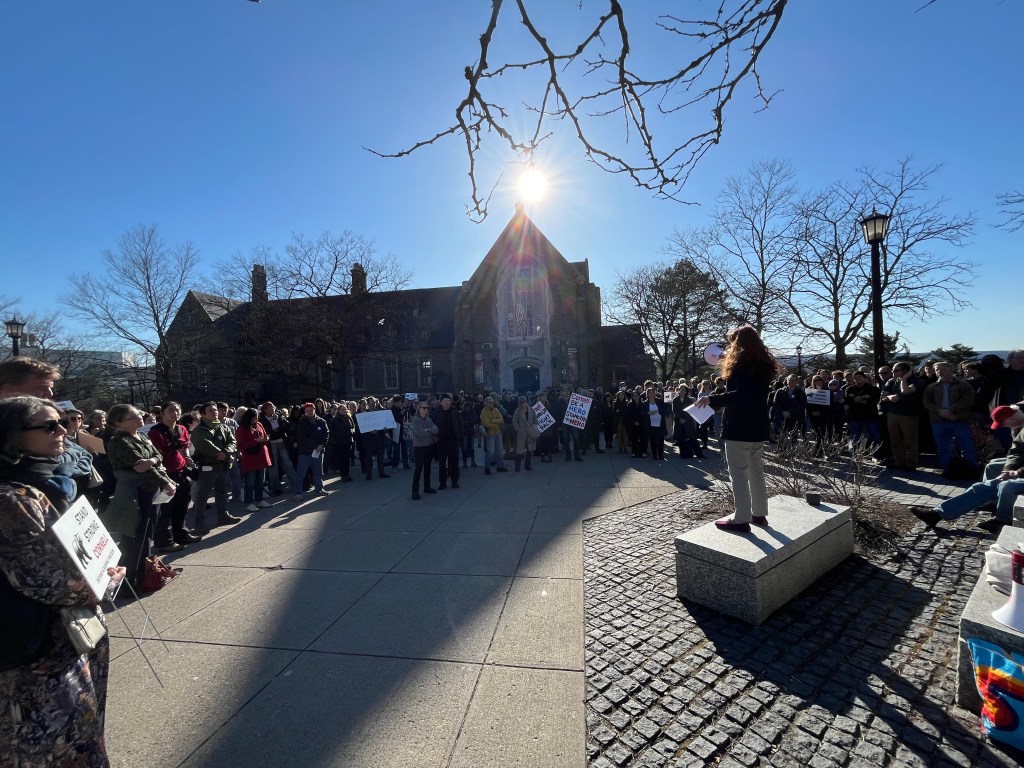
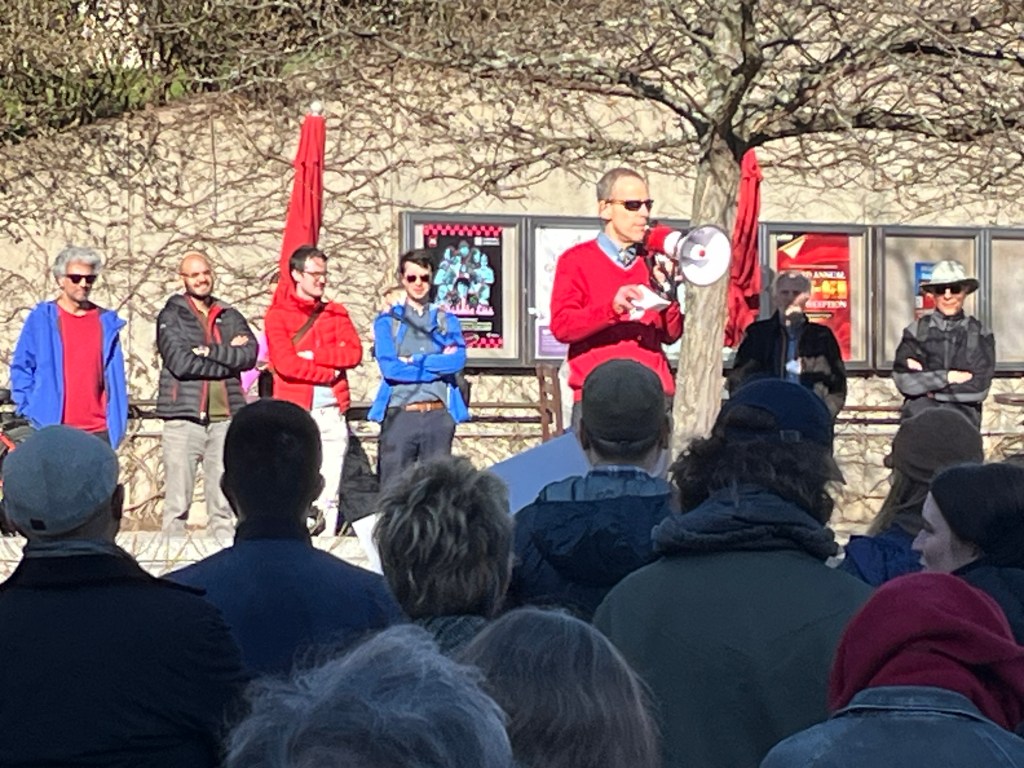
The April 17 National Day of Action had a great turnout at Cornell. We had speakers from across the university, in the sciences, humanities and social sciences, and the law school.

Michael Dorf’s remarks were not printed, and so don’t lend themselves to being re-printed. Instead, we cross-post material from his blog – www.dorfonlaw.org – which was also posted at the Chronicle of Higher Education.
Harvard University’s rejection of the Trump administration’s April 11 demand letter (styled as a proposed agreement in principle) almost immediately led the White House to announce a freeze on $2.2 billion in federal funds to Harvard. Undoubtedly, Harvard’s leadership contemplated such an announcement as a possible consequence of its resistance. Thus, its decision deserves either praise for courage or condemnation for foolhardiness. I choose praise–in no small part because, as we have already seen with Columbia, capitulation to President Donald Trump’s demands brings only more demands. There’s no point in selling your soul if all you receive in exchange is a worthless I.O.U.

That’s generally the way things work with bullies and hostage takers. Appeasement leads to more bullying and more hostage taking. But there’s an additional reason why appeasement by universities will not work in the current moment. The anti-intellectual ideologues (no, that’s not an oxymoron) running education policy within and adjacent to the White House do not wish to reform higher education; they want to break it. A university that concludes it can survive only by bending to the Trump administration’s demands will find that what survives is not recognizable as a university.

Consider just one aspect of the astounding ultimatum that three agencies of the Trump administration sent to Harvard. It contained this demand: “Every department or field found to lack viewpoint diversity must be reformed by hiring a critical mass of new faculty within that department or field who will provide viewpoint diversity.”

“Every department” includes the sciences. I majored in physics at Harvard in the 1980s. At the time, there was debate about how many dimensions of space-time string theory should postulate as well as whether string theory was valuable at all, given its failure to make falsifiable predictions. Similar debates now rage. Suppose Harvard had acceded to the administration’s demands, including for viewpoint diversity. The administration’s proposed agreement included a requirement that Harvard appoint “an external party, which shall satisfy the federal government as to its competence and good faith” to conduct a viewpoint diversity audit. How exactly would such a body decide how many string theorists, how many string theory skeptics, how many solid state physicists, how many cosmologists, and how many experimentalists the Harvard physics department should employ to achieve adequate viewpoint diversity?

Perhaps the Trump administration wouldn’t care about diverse views about physics. After all, the focus of the viewpoint diversity demand are supposed “criteria, preferences, and practices . . . that function as ideological litmus tests.” But what counts as ideological?

House Speaker Mike Johnson–a close Trump ally–has done legal work for the Creation Museum and Ark Encounter, which he describes as “one way to bring people to this recognition of the truth, that what we read in the Bible are actual historical events.” Other so-called “young Earth creationists” are likely well represented in the Trump administration. If Harvard had acceded to the administration’s demands, would it have been obligated to hire creationists to its biology and geology faculty to achieve viewpoint diversity? It is not unrealistic to think that any auditor the Trump administration would approve would regard acceptance of evolution as an unacceptable ideological litmus test. So too for acceptance of the reality of human-generated climate change.

To be clear, substantial viewpoint diversity is often a virtue in an academic institution, at least when the varying viewpoints reflect the diversity of views among knowledgeable people in a field. An economics department can benefit from interchange among and opportunities for students to study with neoclassicists, Keynesians, and monetarists. Methodological diversity is also valuable. Most good law school faculties include doctrinalists, legal historians, empiricists, philosophers, economists, critical theorists, and more.

However, that doesn’t mean that all forms of viewpoint diversity are equally valuable or even valuable at all. The creationism example makes that clear for the natural sciences, but the observation also holds true in the humanities, the social sciences, and professional schools. Is a philosophy department sufficiently diverse if it numbers among its moral philosophers utilitarians, deontologists, and skeptics but no Aristotelians who believe that some people are rightly born to be enslaved? Must a political science department appoint people whose work asserts that the 2020 Presidential election was stolen, even if they offer no credible evidence for that view? Should a medical school be required to diversify its faculty by adding anti-vaxxers?

Those and countless other examples that could be marshaled illustrate the proposition that–as Yale Law Professor and former Dean Robert Post has argued at much greater length–academic freedom properly exists within disciplinary boundaries defined by people with relevant expertise. The point is not that experts always know best or that the conventional wisdom is always correct. On the contrary, disciplinary assumptions should always be open to challenge through evidence and argument. But not all evidence and not all arguments are equal–and thus neither are all viewpoints.

Moreover, it should be open to an academic institution to build on its strength. The University of Chicago economics department in the 1970s and 1980s grew its reputation by favoring libertarian-leaning neoclassicists. The Yale English Department became a center of deconstructionism in the same period. In my own field of law, the George Mason University Antonin Scalia Law School and the University of San Diego Law School have made constitutional originalism a focus of their faculty and programs. Whatever one thinks of any of these particular orientations, they reflect legitimate choices that create cross-fertilization of ideas among like-minded scholars and special opportunities for students who wish to study from a particular viewpoint or methodology. Specialization of this sort contributes to what Yale Law Dean Heather Gerken has aptly called “second-order diversity,” which is itself valuable and, in any event, should be a matter of institutional self-direction.

Meanwhile, the same Trump administration demand letter that, in the name of diversity, would impose on Harvard an affirmative action program for under-represented viewpoints–surely intended to mean conservative ones–also demands that Harvard “shutter all diversity, equity, and inclusion (DEI) programs, offices, committees, positions, and initiatives.” The letter thus reveals its own lawlessness. Recipients of federal funds like Harvard have implemented DEI programs in part to satisfy their obligations under Title VI of the 1964 Civil Rights Act. Yet the Trump administration demands that such programs–which it is charged with enforcing–be shut down and a new one wholly outside its jurisdiction and in no way responsive to any illegal conduct be erected in its place.

Harvard was right to reject the Trump administration’s unlawful and unreasonable demands. Other universities in the administration’s crosshairs should take inspiration from its leadership.

Michael C. Dorf is the Robert S. Stevens Professor of Law
National day of action speeches, David Bateman

The April 17 National Day of Action had a great turnout at Cornell. We had speakers from across the university, in the sciences, humanities and social sciences, and the law school. We reprint some of these here.

I can’t tell you how heartening it is to see so many of you here today. And to know that we are just one of hundreds of rallies being held across the country as part of our national day of action.

In addition to being VP of the Cornell chapter of the AAUP, I’m also a political scientist who studies democratization and its reverse – the decline into authoritarianism. The attacks on higher education we’re seeing today are unprecedented in this country in their scope and severity. But they are not new. They are taken straight from the authoritarian playbook, from Russia, to Hungary, to Venezuela, to Turkey to Florida and now to the federal government. For many of our international colleagues, what they’re seeing now is terrifying but entirely familiar.  

Authoritarians have always targeted universities. Why? I often hear that it’s because an uneducated population is a compliant population. I don’t think that’s quite right. I think there are two fundamental reasons:

(1) Attacks on universities are part of a broader assault on civil society. Suing CBS or ABC because of their coverage, or threatening to strip them of their broadcast license; going after law firms that worked for causes you dislike; threatening to punish businesses and organizations that step out line. Authoritarianism cannot tolerate a robust and independent civil society.

In today’s competitive authoritarianism, where elections still happen, rigging the playing field of civil society is essential to securing authoritarian rule. Universities are part of that.

(2) the second reason is more fundamental. The pretext for attacking universities has changed – anti-communism, anti-DEI, anti-woke – but the goal has stayed the same: to frame the University as an anomalous space outside the mainstream of American life, a topsy-turvy inversion of social hierarchies, where people are supposedly promoted on the basis of DEI rather than merit, where faculty can’t be fired and in fact are supposed to govern, where students are free to pursue their interests, to disobey, with consequences for sure but with consequences calibrated to the idea that the university exists precisely in order to give students and researchers and teachers the freedom necessary to discover.

The authoritarian story about universities works to naturalize and justify social hierarchies by creating a fictional version of the university where these are inverted.

But it has this kernel of truth to it: The standards of excellence in a university are in many ways not the same as they are elsewhere. The standards are not how much money you make. They are not how well you convert knowledge into commercial applications. That might happen, might be encouraged, might be a good thing, but the goal is the knowledge first and foremost.

But it isn’t even the knowledge that is most threatening to authoritarians. It’s the practices and protections of academic freedom – the institutional guarantees that allow us to pursue understanding and knowledge and to merit them for their own sake – that are threatening to them. And like all bullies, they threaten in turn that which threatens them.

So what’s our strategy? How do we respond?

Well, first off we can only respond collectively. What’s the song say? “For what force on earth is weaker than the feeble strength of one?” The first step, the one we’re taking today, is to come together and stand together!

This is not going to be easy. We’re here today in force. But what about tomorrow, when the Trump administration says that it might restore funding if this program is axed, if these students are expelled and deported, if these courses are shut down?

We know their strategy. It’s to divide us, or to keep us divided. They count on us turning against each other – treating this program as expendable, this person as disposable. They target the sciences, hopeful the sciences will turn on the humanities or that the humanities will look the other way. They target international students in order to silence all students. They hope that tenured faculty will see untenured colleagues – staff, RTE faculty – fired and turn away.

One of the big lies of authoritarianism is that they will oppress one without oppressing the other; that they can cut out one person – the immigrant, the climate scientist, the transgendered student – and leave the rest intact.

But it’s a lie.

“Any person any study” might be a motto or a principle. But it’s also a basic truth: you are not really free to study at all if you are not free to study all and to go wherever your studies take you.

So in coming together today, let us pledge to each other that no part of the University is expendable. No person at the University is disposable.

Second: The resistance to authoritarianism is going to come from below. And it’s going to work in part by making it clear to our organizations and institutions that we will not accept rolling over. We need to give our leadership and our allies the courage of their convictions.

So I want to thank Mike Kotlikoff for joining two national lawsuits. As he put it, Cornell cannot compromise on its core mission, “to do the most good,” or its core values of “any person any study” and academic freedom.

I want to thank him for throwing our hat in the ring. But it’s also going to take a lot more than those two hats!

University leadership has talked about how they want other universities, public universities in red states for example, to take the lead, because the ivies are too unpopular. Now, when those universities were under attack, the ivies said, well it wouldn’t do them any good for us, who are so unpopular, to come out in their defense.

We can’t accept that. If we won’t lead, no one will. Harvard has now set an example. And that’s really got to burn. But they do so after making huge concessions already, when they realized that no amount of conceding would provide protection. That lesson needed to be learned, but as of now there is no excuse for not having learned it.  

Our leadership also includes the board of trustees. There’s been a lot of fear among the trustees, a belief that the university needs to get as close to Trump administration as possible, that doing so will protect us. But that’s not how this work. You cannot protect us by sacrificing who we are! You cannot save the University by demolishing it.

And our allies include New York State officials. Cornell is New York State’s public land grant college. It is one of its flagship institutions. It is state law that establishes the University Faculty at Cornell as the people responsible for setting education policy. It is state law that has established our majors and minors. It is state law that determines most of our diversity, equity, and inclusion policies. State law and authority are threatened by the federal assault on higher education and academic freedom. Cornell is one of the economic anchors of our region. And yet our state officials have so far been silent. They cannot be silent any longer.

Our potential allies include the Democratic Party in Congress. At some point the government will need to be funded – they should do everything in their power to demand a complete end of the assault on higher education and the reversal of those unlawful policies, as well as any stray lawful ones, that constitute this assault.

Finally – it is on us to hold the line. In our organizations, on campus and off; in our institutions of shared governance; in our committees; in our public and private advocacy.

When someone says, we’d better scrub our diversity, equity, and inclusion principles from the website. No. We hold the line.

When someone says, we should comply with this order, despite its being contrary to our values. No. We hold the line.

When the federal government sends its version of the demands it sent to Columbia or Harvard, demanding this or that program be dismantled or put under new leadership acceptable to the federal government. No. We hold the line.

That’s the strategy. We stand together in solidarity. We pledge to each other, that no part of the university is expendable, no person disposable. That we – and not would-be, and if we don’t stop them, will-be authoritarian bullies – determine the educational policy of the University. We support our leadership in fighting back, and push them to do more. We hold the line.

David Bateman is vice president of the Cornell chapter of the AAUP, and is an associate professor in the Government Department and in the Jeb E. Brooks School of Public Policy.

National day of action speeches, Lara Estroff

The April 17 National Day of Action had a great turnout at Cornell. We had speakers from across the university, in the sciences, humanities and social sciences, and the law school. We reprint some of these here.

My name is Lara Estroff.  I am speaking to you today as a Materials Science and Engineering Professor.

For longer than any of us has been a student or a faculty member, there has been a thriving partnership between American universities and the United States government, committed to educating and training generations of scientists and engineers who have gone on to impactful careers that have made America a healthier, safer, and more technologically advanced society. This partnership has led to innovations that have resulted in faster, more compact consumer electronics, safer airplanes, life-saving vaccines, and more sustainable energy production.

This educational ecosystem is a shining example on the international stage and we attract students from all over the world who want to come and be trained at American universities. 

Today, this partnership is threatened because one of the partners, the United States government, is threatening to withdraw. Disruption to this partnership will hurt not only current students and faculty at this and many other great universities, but it also threatens to damage our future as a country.

Now, I want to help us all understand how the money awarded to faculty in grants and contracts from federal funding agencies is actually used. The budgets for these grants have roughly three parts to them: funds to cover the educational costs for our graduate students; the materials and supplies associated with doing this cutting-edge research; and the indirect costs, called “facilities and administrative” or F&A costs, that go to the university.

These F&A costs are what we’ve heard about both in the news and in the emails from President Kotlikof and Provost Bala in regard to recent illegal actions taken by both the National Institutes of Health and the Department of Energy aimed at significantly reducing the F&A rate we can include in our budgets.  Cornell has played an essential role in helping to halt both of these actions from being implemented through court-ordered injunctions, but the fight is not over!

At the end of World War II, when the partnership between universities and the government was forged, there was a realization that universities, as engines of innovation, were the ideal place to be training the scientists and engineers the US needed to have scientific and technological leadership in the world. But in order to do so, the infrastructure at these universities would need to be expanded to enable and support fundamental scientific and engineering research.

These may not be “sexy things” but they are incredibly important for doing our work: like laboratories with fume hoods and biosafety equipment, libraries with up-to-date and well-curated collections, cleanrooms for microelectronics fabrication like CNF, chemical and biological waste handling and disposal facilities, and state-of-the-art characterization facilities like CHESS. This infrastructure is expensive to develop and maintain; we’re talking about utility bills and technicians to service the equipment.  We’re also talking about the administration costs related to ensuring research integrity and ethical performance of studies involving animals and humans, and much more. All of these costs are substantial and necessary; and require a continuous, rather than a one time, investment.

Without these funds coming into the university, our very mission is threatened. We will be unable to train the next generation of scientists and engineers who are going to be at the forefront of discovery in the coming decades; we will be unable to perform the fundamental research that will lead to innovative new therapies for disease, cleaner drinking water, and more sustainable construction materials for our built environment.

My colleagues and I are speaking with one voice. Some of us identify as Republicans, some as Independents, some as Democrats but we ALL recognize that standing up to the Trump administration is going to come with very real economic impact on our labs and our students.  We are ready to take on these sacrifices to ensure that our academic freedoms, our ability to hire faculty and admit students according to our values and our educational mission, is not taken away and put under government oversight as we might expect from some other countries but NEVER in the United States of America!  Cornell’s founding principal of “any person, any study” has endured and been a guiding light for 170 years.  It is worth far more than $1 Billion.  It will not be extinguished on our watch.

We are ready to fight and we are ready to make these sacrifices, but we need to do this together.

Lara Estroff is Chair of the Department of Materials Science and Engineering and Herbert Fisk Johnson Professor of Industrial Chemistry

National day of action speeches, Alyssa Apsel

The April 17 National Day of Action had a great turnout at Cornell. We had speakers from across the university, in the sciences, humanities and social sciences, and the law school. We reprint some of these here.

My name is Alyssa Apsel.

I am speaking to you today as an Electrical and Computer Engineering Professor.  Over in the Engineering school we take our roles as teachers and researchers very seriously.  Most of us would much rather be in the lab then out here talking about public policy.

We like to indoctrinate our students with things like

  • Kirchoff’s current laws
  • Digital Logic
  • Stochastic Processes
  • Computer Architecture
  • Charge transport models

As well as numerous other highly polarizing topics. 

So last week we, along with many other departments in the college of engineering received stop work orders on tens of millions of dollars of research contracts with the department of defense.  Across the college of Engineering, these contracts were awarded to conduct research on things including:

  • The design of advanced systems to control electromagnetic emission and absorption with implications for 1) stealth technology (radar detection) 2)thermal management (cooling) 3) efficient electricity generation from photovoltaics
  • Materials for high voltage and high temperature electronics to support things like propulsion systems.
  • Modeling of quantum mechanical systems to enable development of complex quantum computers.
  • Development of novel propellants for space crafts
  • As well as grants training workers to build satellites

Each of these research topics makes the US more secure, drives economic growth, and positions us in a research leadership position. 

It’s notable that US universities perform roughly half of the basic research done in the US.  Eliminating research from US universities will strictly weaken the US, both economically, and as a respected knowledge leader.  We will be less competitive globally and have less technology readiness.  This will probably make China and Russia quite happy. 

Beyond this, it is important to realize that University Research IS education. 

Our undergraduate programs can exist without federal research dollars, but graduate education in the sciences and engineering cannot and will not. 

Federal Contracts pay these students.  Period. 

This administration trying to wipe out both sciences today but also the next generation of scientists and decimate engineering research for decades to come. 

This is not hyperbole.  The top students will not stay in a country that does not welcome and support them.  They will go to Europe, or Asia, or whatever greener pasture welcomes them and the US will lose leadership status.

It really is that simple.

And on the topic of trade deficits, you know what our highest domestic export is? Education.  Not soybeans, or corn or natural gas, it’s education.  This is what these morons are trying to destroy. 

So, you wonder, given that we are teaching students math and science and physics, why would Trump and his cronies want to destroy us? 

Because truth is inherently political with this administration, and therefor dangerous.

If you are in the business of trying to convince people that up is down and left is right, you can’t have some professor showing up with data about gravity.

You can’t have an engineer showing that alternative power sources are actually feasible, or that lead in the pipes might cause disease and brain damage. You just can’t.  That’s dangerous.  They fear it.  So now they want us to be scared.   

So we can’t be.  We need to stand up, speak out, and organize.  They fear us because we have power.  We need to use that power. 

The folks attacking us, speak out of two sides of their mouths.  They hate us, but they also desperately want us to educate their kids.  That’s power.

They Ivy league and other large universities have a large base of alumni with resources.  They can work together and reconsider a joint plan of action.  That is power. 

We need to support each other because otherwise it does not end well for us.  What great research comes out of Hungary, I ask you?

Ordinarily and engineering prof like myself would much rather be in the lab then out here, but this, this is existential.  And I promise that like me, others are up for this fight.

Thank you. 

Alyssa Apsel is the Ellis L. Phillips Sr. Director of Electrical and Computer Engineering and IBM Professor of Engineering

National day of action speeches, Sandra Babcock

The April 17 National Day of Action had a great turnout at Cornell. We had speakers from across the university, in the sciences, humanities and social sciences, and the law school. We reprint some of these here.

This demonstration is a call to arms for the defense of higher education.

We are calling on Cornell to STAND UP AND FIGHT BACK, because higher education is worth defending.

There are a lot of false narratives circulating these days about higher education.

People say our students are either privileged puffballs or left-wing lunatics.

People say that faculty are either cocooned in ivory towers where they are completely untethered to the day-to-day concerns of ordinary folks, or they are scheming to indoctrinate our students in dangerous and subversive ideologies.

And recently, people have been saying that universities are hotbeds of anti-semitism.

These are all false narratives, and those who promote them are profoundly ignorant of who we are, what we do, and how we do it.

Let’s start with the students.  Our 26,000 students are incredibly diverse. They don’t come to us as empty vessels waiting for us to pour our ideological perspectives into their waiting brains. They are smart and they know how to think for themselves. Many of them have experienced economic precarity, others have undergone tremendous hardships, and yes, some come from more elite backgrounds. But whatever their backgrounds, the vast majority are thoughtful and eager to learn.

Cornell’s best students are also deeply principled and empathetic. They care about the world we live in. They care about the suffering of people in Darfur, in Ukraine, in Xinjiang China, and in Gaza.  And when they speak out about injustice, and when they make us uncomfortable with their demands, they are doing precisely what students have done for generations.

Our student protestors are human rights defenders who deserve our protection and support under international human rights law. The UN expert on the Rights of Freedom of Peaceful Assembly and of Association wrote recently that the university Palestinian solidarity protest movement demonstrated “the profound sensibility, civic responsibility, and creative potential of youth.” And the UN expert on human rights defenders has pointed out that youth and children “are at the forefront, and often the main driving force, of societal, economic and political change.” We must forcefully resist the false narrative that student protestors are criminals or terrorists—and University leadership must likewise resist the pressure to subject them to ever-more severe disciplinary measures that jeopardize their safety and their futures.

As for our faculty – let’s talk about some of the life-saving, transformative work that we’re doing in communities in New York, around the United States, and throughout the world. Many of our faculty may lose their jobs under the government’s threatened funding freeze.

At the Cornell Medical School, the faculty who are most vulnerable to job cuts carry out life changing medical research, take care of you and your families when you are sick, and educate future generations of researchers and doctors so that someone will be around to take care of your children and grandchildren.

At Cornell Law School, the most vulnerable faculty are those who, together with law students, are helping low-income taxpayers in rural Alaska fill out their tax returns so they can receive government refunds, or those who are training students to obtain justice for women in the military who are sexual assault survivors. The most vulnerable faculty at the Cornell School of Agriculture and Life Sciences are involved in educating small farmers in Central New York about how they can mitigate the impact of climate change and grow crops that supply regional food systems.

These are just a few examples of what we call RTE faculty – faculty who lack tenure, who work on short-term contracts with little job protection. There are over 1,300 of us working across Cornell. Our work is more vital than ever as government programs are cut and communities lose access to resources. But without job security, we—together with the staff who keep many University programs running—will be the first casualties of federal funding cuts. We need greater pathways to tenure and more job security—and for that, we need the support of our tenured colleagues and the administration. This is a moment where we should stand together to strengthen our institution, not weaken it.

When we stand together, we are STRONG.

When we read about “Cornell University” in the news, those stories are often referring to the actions of our President and Cornell’s Board of Trustees. But they are not Cornell. We who are standing here today are Cornell.

Our librarians ARE CORNELL.

Our staff ARE CORNELL.

Our faculty ARE CORNELL.

Our extension workers ARE CORNELL.

Our students ARE CORNELL.

And we want the Board of Trustees and the President to HEAR OUR VOICE. We are Cornell, and we will not be silenced.

Sandra Babcock is Clinical Professor of Law, specializing in international human rights litigation, access to justice, death penalty defense, international gender rights, and the application of international law in US courts.