Defending academic freedom, shared governance, the economic security, the rights of all those who teach or conduct research in higher education, advocating for the interests of the broader community, whether in Ithaca, Tompkins County, or beyond, and protecting higher education as a public good
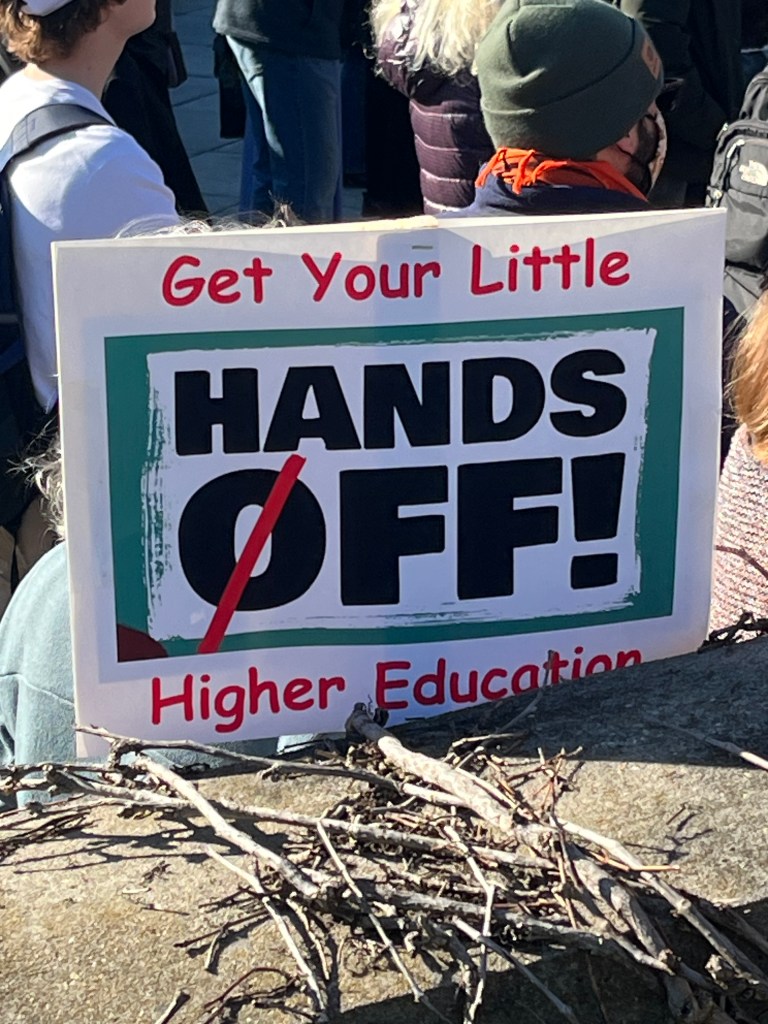
The April 17 National Day of Action had a great turnout at Cornell. We had speakers from across the university, in the sciences, humanities and social sciences, and the law school. We reprint some of these here.
This demonstration is a call to arms for the defense of higher education.
We are calling on Cornell to STAND UP AND FIGHT BACK, because higher education is worth defending.
There are a lot of false narratives circulating these days about higher education.
People say our students are either privileged puffballs or left-wing lunatics.
People say that faculty are either cocooned in ivory towers where they are completely untethered to the day-to-day concerns of ordinary folks, or they are scheming to indoctrinate our students in dangerous and subversive ideologies.
And recently, people have been saying that universities are hotbeds of anti-semitism.
These are all false narratives, and those who promote them are profoundly ignorant of who we are, what we do, and how we do it.
Let’s start with the students. Our 26,000 students are incredibly diverse. They don’t come to us as empty vessels waiting for us to pour our ideological perspectives into their waiting brains. They are smart and they know how to think for themselves. Many of them have experienced economic precarity, others have undergone tremendous hardships, and yes, some come from more elite backgrounds. But whatever their backgrounds, the vast majority are thoughtful and eager to learn.
Cornell’s best students are also deeply principled and empathetic. They care about the world we live in. They care about the suffering of people in Darfur, in Ukraine, in Xinjiang China, and in Gaza. And when they speak out about injustice, and when they make us uncomfortable with their demands, they are doing precisely what students have done for generations.
Our student protestors are human rights defenders who deserve our protection and support under international human rights law. The UN expert on the Rights of Freedom of Peaceful Assembly and of Association wrote recently that the university Palestinian solidarity protest movement demonstrated “the profound sensibility, civic responsibility, and creative potential of youth.” And the UN expert on human rights defenders has pointed out that youth and children “are at the forefront, and often the main driving force, of societal, economic and political change.” We must forcefully resist the false narrative that student protestors are criminals or terrorists—and University leadership must likewise resist the pressure to subject them to ever-more severe disciplinary measures that jeopardize their safety and their futures.
As for our faculty – let’s talk about some of the life-saving, transformative work that we’re doing in communities in New York, around the United States, and throughout the world. Many of our faculty may lose their jobs under the government’s threatened funding freeze.
At the Cornell Medical School, the faculty who are most vulnerable to job cuts carry out life changing medical research, take care of you and your families when you are sick, and educate future generations of researchers and doctors so that someone will be around to take care of your children and grandchildren.
At Cornell Law School, the most vulnerable faculty are those who, together with law students, are helping low-income taxpayers in rural Alaska fill out their tax returns so they can receive government refunds, or those who are training students to obtain justice for women in the military who are sexual assault survivors. The most vulnerable faculty at the Cornell School of Agriculture and Life Sciences are involved in educating small farmers in Central New York about how they can mitigate the impact of climate change and grow crops that supply regional food systems.
These are just a few examples of what we call RTE faculty – faculty who lack tenure, who work on short-term contracts with little job protection. There are over 1,300 of us working across Cornell. Our work is more vital than ever as government programs are cut and communities lose access to resources. But without job security, we—together with the staff who keep many University programs running—will be the first casualties of federal funding cuts. We need greater pathways to tenure and more job security—and for that, we need the support of our tenured colleagues and the administration. This is a moment where we should stand together to strengthen our institution, not weaken it.
When we stand together, we are STRONG.
When we read about “Cornell University” in the news, those stories are often referring to the actions of our President and Cornell’s Board of Trustees. But they are not Cornell. We who are standing here today are Cornell.
Our librarians ARE CORNELL.
Our staff ARE CORNELL.
Our faculty ARE CORNELL.
Our extension workers ARE CORNELL.
Our students ARE CORNELL.
And we want the Board of Trustees and the President to HEAR OUR VOICE. We are Cornell, and we will not be silenced.
Sandra Babcock is Clinical Professor of Law, specializing in international human rights litigation, access to justice, death penalty defense, international gender rights, and the application of international law in US courts.
Cornell AAUP chapter member Eric Cheyfitz has a fantastic piece in the Daily Sun, putting recent university developments within the longer history of the evisceration of meaningful faculty and shared governance at Cornell.
“By fiat, the Board of Trustees has just appointed Interim President Michael Kotlikoff as the 15th president of Cornell University. For the first time in my 22 years here as a tenured member of the faculty, there has been no national search for the university presidency. Such searches typically include faculty. So this suspension of a search is one more sign of the decline in faculty governance, which has been declining rapidly at Cornell … The increasing decline of faculty governance nationally has gone hand-in-hand with the rise of the corporate university, which, over a hundred years ago, Thorstein Veblen recognized in his 1918 book The Higher Learning in America. Today, by and large, university presidents play the role of CEO, taking their agendas largely from boards of trustees and donors rather than faculties. President Kotlikoff fits squarely in this mold at a time when the corporate model has become particularly toxic with the Trump administration’s assault on liberal education with its foundation in free speech and academic freedom. “
The director for the AAUP Center for the Defense of Academic Freedom, Isaac Kamola, is sharing resources for the fight:
The cruelty of the new administration’s attack on democracy and higher education has been staggering, from arbitrary cuts to research funding to the malicious misrepresentation of our work to Linda McMahon’s unwillingness to say that teaching African American history is still legal.
Fighting back requires understanding the threats we face as well as developing the tools necessary to convey the value of higher education to a wide audience. In this context, the AAUP’s Center for the Defense of Academic Freedom has recently published a number of resources that we hope will be useful in the fight ahead:
Academic Freedom on the Line is a weekly Substack edited by CDAF fellow John Warner. This newsletter examines questions around academic freedom, its role in a democratic society, and what is lost when academic communities face politicized attacks on institutional autonomy and shared governance. Check out posts on CDAF’s mission, the risks of obeying in advance, advice for college and university boards, and reflections on the recent “Dear Colleague” letter.
Executive Power Watch is a series of short handouts that offer analyses of education-related executive actions, including executive orders that target diversity, equity, and inclusion; weaponize antisemitism; and target transgender, intersex, and nonbinary people. These resources offer concrete suggestions about what you can do to fight back.
Action Reports are short studies that offer concrete analysis and guidance on how to respond to particular threats to academic freedom, such as
Future Action Reports will examine the American Council of Trustees and Alumni and strategies for using collective bargaining agreements to resist post-tenure review laws.
Yesterday evening, the AAUP, along with the National Association of Diversity Officers in Higher Education and other partners filed a lawsuit to block Trump’s unlawful and unconstitutional DEI executive orders, which threaten academic freedom and access to higher education.The lawsuit, which can be read in full here, argues that Trump’s orders exceed his legal authority, are overly vague, and fail to define such terms as “DEI,” “equity,” and “illegal DEIA.” Without any definitive criteria or information, the orders open academic institutions to the risk of lawsuits for policies that promote diversity, equity, and inclusion.The AAUP has long advocated for diversity in higher education, including a diverse faculty and student body. The Association’s recent statement On Eliminating Discrimination and Achieving Equality in Higher Education focuses on diversity in faculty employment within an integrated understanding of how to move toward the broader goal of inclusion and equality in higher education.
On Monday, November 11, an article appeared in the Jewish Telegraphic Agency article in which Cornell President Michael Kotlikoff was quoted denouncing a course scheduled to be taught by Cornell faculty member Eric Cheyfitz titled “Gaza, Indigeneity and Resistance”. Kotlikoff went further to question the integrity of the College of Agricultural and Life Sciences college curriculum committee for approving a course he objected to on transparently political grounds. And he asserted that he was actively working with colleagues in other departments to develop courses that will offer more “objective” courses on the topic. In other words, that conform to political criteria for how Palestine should be studied and taught (or not) at Cornell.
The story made national and international news, and Cheyfitz and his family began receiving hate mail including obscene calls for violence against his wife, children and grandchildren. Kotlikoff confirmed to Cheyfitz that he wrote the quotes attributed to him, but did not apologize.
Kotlikoff’s remarks are an egregious threat to bedrock principles of academic freedom, as well as Cornell’s commitment to “any person, any study.” They raise the specter of administrative interference in faculty control over curricular decisions and course instruction. They suggest that, despite repeated disavowals, the leadership of the University not only intends to scrutinize the in-class activities of Cornell faculty but is actively doing so where it is deemed politically desirable. Ultimately, his comments and actions threaten to degrade the quality of education students receive at Cornell and the ability of the University to be a leading center of research and knowledge production.
Kotlikoff’s remarks are not justifiable on the basis of his authority as University president. Faculty control over education is an essential component of academic freedom. This principle is manifested institutionally in several ways, from the authority of the University Faculty – delegated to the Faculty Senate – over general educational policy, to the authority of faculty of any particular college or school to determine its own courses of study, including the offering of any new majors or minors, to the faculty-led curricular or educational policy committees in each college or school, which determine the relevant educational policies and ensures new courses are compliant with state credit requirements or accreditation requirements.
As “chief educational officer,” the president is a member of the faculty and serves as an ex officio member of the more general bodies. But the president’s role is most extensive in matters of general educational policy, and most circumscribed or absent when it comes to specific courses or curricula. He does not serve on the educational policy or curricular committees tasked with making decisions about specific courses.
This reflects a recognition that while the president is charged with overseeing the general educational policy of the University, the office’s broad authority could pose a threat to academic freedom and the quality of education were it to be exercised at the level of curricular design or classroom instruction. As former President Pollack acknowledged in the context of proposals for new majors, such decisions are rightly “the domain of faculty members,” who are “in the best position to understand the disciplinary context and student interest.” This is even more true at the level of specific courses and classroom instruction.
Presidential authority is also limited by corresponding responsibilities to not only respect but jealously defend academic freedom. As Cornell’s policy commitments put it, a core pillar of academic freedom is “freedom of expression in the classroom on matters relevant to the subject and the purpose of the course and of choice of methods in classroom teaching.”
Academic freedom and faculty control over education requires that curricular and educational policy committees be protected against interference or administrative pressure, whether used to suppress a course or create new ones, and that they show broad deference to individual faculty’s expertise. While these committees might reasonably require some level of standardization in core courses, they generally avoid inspecting instructors’ substantive choices over readings or topics, especially in non-core courses. It is unreasonable to expect that any individual or committee could develop sufficient area expertise to evaluate the great diversity of courses taught at Cornell or in any school or college. More important, restraint and deference to faculty expertise is essential to realizing the public mission of universities as well as the specific values of “any person, any study” at Cornell. The members of the curricular and educational policy committees work carefully and in good faith to achieve this balance, ensuring that the overall curricular goals of the college or school are being achieved, that state and accreditation requirements are met, and that academic freedom in the offering and design of individual courses is respected and defended. Their efforts should not be carelessly dismissed by leadership, nor subjected to pressure from it.
Unlike Professor Cheyfitz, who has been teaching and publishing in this area for decades, President Kotlikoff is not an expert on Palestine/Israel and has no academic basis for objecting to the content of a course that has not yet been taught, in a field of study in which he has never been active, and in a discipline and program of which he is not a member. More important, his institutional responsibilities preclude him from weighing in on what courses individual instructors choose to teach or to question how they structure their syllabi, or on the decisions and deliberations of the relevant faculty committees that approve these courses. It is not just distasteful to second-guess and decry his faculty colleagues, whether individuals such as Cheyfitz or the responsible faculty bodies such as the curriculum committee. It is an abuse of his institutional position.
Most worrisome, Kotlikoff’s email is indicative of broader patterns that have become evident over the last year: the undermining of academic freedom and faculty control over education based on political litmus tests; and a reckless willingness to throw faculty, students, and staff under the bus when they become political targets, sharing information or administrative opinions about them with individuals or institutions with no legal right to know.
Nor are Kotlikoff’s comments excused by the context in which they were delivered. The quote was taken from an email sent to a Cornell faculty member, who then shared it with the press. But this was not private kvetching. The only reason Kotlikoff was asked his views is because he is president, and he must have reasonably expected to be read not as stating a personal opinion but as communicating University policy.
Kotlikoff’s email comes only a month after Cornell Vice President for University Relations Joel Malina was recorded, in a private meeting with parents, promising that in-class instruction activities for all faculty would be scrutinized. He singled out two faculty members in particular, whether because he had decided that their personal political positions were upsetting to some of the parents or because the administrators themselves had objected to the faculty members’ politics. In response to the ensuing outcry against this clear violation of academic freedom in teaching, Interim Provost John Siliciano repeatedly assured the governing bodies that Malina’s statements did not reflect Cornell policy. Kotlikoff’s email suggests, to the contrary, that such scrutiny is already occurring, or at least is when a course involves Israel/Palestine and is being taught by instructors who might present perspectives that do not conform to political criteria.
Last spring, we witnessed how Cornell would respond to politically motivated attacks on the University. Congressional committees demanded that specific student organizations be punished; Cornell immediately began changing its rules and processes to comply, in violation of established processes of shared governance. Where rule changes were insufficient, Cornell leadership pushed ahead and violated explicit constraints on the use of temporary suspensions, punishing students for whom there was not even a prima facia case for having violated any Cornell policy let alone rising to the level of immediate threat for which temporary suspensions are designed. Faculty and staff have been singled out for investigation and discipline based on their political views.
When remarks at an off-campus rally by a faculty member in the College of Arts and Sciences generated a political backlash, the president and provost announced that they found his views appalling and promised to scrutinize his teaching to find some plausible basis for revoking tenure. They announced this publicly, even as Kotlikoff – then provost – repeatedly assured faculty bodies in private closed sessions that he saw no possible reason to believe that the faculty member had violated Cornell policies. To politicians and other outside actors, they fueled the fire, contributing to the extraordinary wave of threats and harassment this faculty member and their family faced. They did this while privately assuring concerned faculty that there was nothing to worry about.
Political attacks on the University are only going to get worse. The question is how the University will respond. Will it continue to recklessly denounce faculty, students, and staff to anyone who asks, be they politicians, parents, donors, or any other random member of the community? Or will the University commit, through its policies and behaviors, to protecting academic freedom and free expression, to protecting shared governance, and to protecting faculty, students, and staff when acting on these principles?
Kotlikoff owes Cheyfitz an apology. He owes the University community something more. He owes us an affirmative, public commitment that going forward University leadership will not respond to inquiries about individual faculty, students, or staff with anything beyond a statement of Cornell’s commitment to academic freedom and free inquiry. If those inquiries are backed by legal authority, he owes us a commitment that the University will use its considerable legal and political resources to contest that authority. He owes us a commitment that he will cease recklessly participating, intentionally or not, in the politically motivated attacks against the University and academic freedom.
 Cornell Chapter of the AAUP