Defending academic freedom, shared governance, the economic security, the rights of all those who teach or conduct research in higher education, advocating for the interests of the broader community, whether in Ithaca, Tompkins County, or beyond, and protecting higher education as a public good
“After months of negotiation, Columbia University announced on July 23 that it had reached an agreement with the Trump administration to resolve investigations into alleged violations of federal anti-discrimination laws. The settlement provides that Columbia will pay fines of $221m over three years, and that in consideration for these payments and other concessions—including concessions made by Columbia as a precondition to the negotiations 1. After it canceled $400m in grants to Columbia in March, the Trump administration demanded that Columbia take a number of steps as a “precondition” to further negotiations. The commitments Columbia made in response, on March 21, are referenced in the July 23 settlement and incorporated into it. Columbia made additional commitments on July 15 without expressly linking them to the Trump administration’s demands. Columbia’s press release announcing the settlement describes the July 23 settlement as “building on” the July 15 commitments.—the Trump administration will reinstate the “vast majority” of the federal grants the government paused or canceled in March. In announcing the settlement, Columbia stated that the settlement’s terms are “carefully crafted to protect the values that define us.” In Columbia’s telling, the settlement “preserves Columbia’s autonomy and authority over faculty hiring, admissions, and academic decision-making.”
We see this differently. As an initial matter, we fear that the Trump administration will view the settlement as validating its most outlandish claims about “diversity, equity, and inclusion” programs, student protests relating to Gaza, and Columbia’s response to allegations of antisemitism. To be sure, Columbia has not admitted wrongdoing—it “denies liability” in the settlement’s first paragraph. But Columbia’s acquiescence to the agreement is nonetheless likely to provide cover for the Trump administration’s ongoing, lawless assault on higher education.
We also have serious concerns about many of the settlement’s terms, as we discuss below. The settlement narrows Columbia’s autonomy with respect to admissions, the hiring and promotion of faculty, and curriculum—all aspects of what the Supreme Court has called the “essential freedoms” of the university. It imposes new rules relating to protest on campus and student discipline that should be entirely the province of the university to decide. It also supplies the Trump administration with ongoing leverage by requiring the university to satisfy nebulous contractual terms and burdensome reporting requirements under the threat of litigation if its compliance is deemed to be less than satisfactory. In addition, the settlement creates a monitoring and surveillance regime that is certain to chill the exercise of freedoms that are central to the university’s mission.
…
But all of us should be clear-eyed about the settlement’s costs. The settlement is an astonishing transfer of autonomy and authority to the government—and not just to the government, but to an administration whose disdain for the values of the academy is demonstrated anew every day. It will have far-reaching implications for free speech and academic freedom at Columbia—even if we assume that the provisions that are susceptible to more than one interpretation will be construed narrowly, as the settlement itself says they should be (¶ 5). We also doubt that the Trump administration will be satisfied with the territory it has won. The settlement does not foreclose the Trump administration from demanding more from Columbia on the basis of the university’s real or imagined failure to comply with the settlement’s terms, or on the basis of purported transgressions that are new or newly discovered. Indeed, the settlement itself gives the administration an array of new tools to use in the service of its coercive campaign.
Those of us at Columbia should understand how our university is being transformed, and those at other universities contemplating similar settlements should understand how much is at stake. We are sympathetic to Columbia’s leaders, who are operating under extraordinary pressure, but we cannot agree that the settlement “protect[s] the values that define us.” “
From the Columbia University Chapter of the AAUP, for immediate release: July 29, 2025
The Agreement between the federal government and Columbia University announced on July 24, 2025, has been presented as a settlement of Title VI violations, specifically the university’s alleged failure to curtail bias and harassment directed toward Jewish faculty, staff, and students. However, as has been pointed out by several of our colleagues, the statutory processes encoding Title VI enforcement have been entirely ignored in arriving at this deal. Far from being a legal settlement, the Agreement merely fulfills the Trump administration’s desire to dominate a prominent university, to diminish its autonomy, and to silence critical speech. This Agreement and the many concessions that have preceded it will ineluctably transform Columbia for the worse and stain its reputation in the eyes of the world.
One-off deals that result from coercion are not only antithetical to the rule of law, but also implicate the university in corrupt and authoritarian practices. The illegal rescission of funds, including research grants, community outreach, and all CUIMC training grants has already caused irreparable damage; threatened permanent reductions in budgets that support science research portend even more profound harm. While this Agreement offers some short-term relief to some of those impacted, there is no reason to believe that the deal is a stable one, given the Trump administration’s record on honoring its commitments and the acknowledgment, in the document itself, that perceived breaches of the terms of the deal may result in additional demands and penalties.
The Agreement is, in short, the blunt instrument through which the Trump Administration has demonstrated its power to bludgeon American universities into undermining the traditions of free and open inquiry, robust political speech, and shared governance that have long distinguished them. Despite the university’s leadership’s claims that Columbia has held true to these fundamental principles, it has not.
The Agreement formalizes recent changes to rules governing student/faculty conduct and discipline, and prescribes the acceleration of hearings and punishments (articles 26-27). It authorizes the review and restructuring of departments and areas of study, mandating new hiring in certain fields (12-13). It imposes ideological tests as a precondition for the admission of international students (21-22). It eliminates diversity as a factor in admissions, hiring, and promotion, while also requiring the sharing of all admissions and hiring data “broken down by race, color and national origin” (18-19). Compliance with these and other measures will be ensured by an internal “Administrator” and an external “Resolution Monitor” with broad yet largely undefined powers (11).
We are already inhabiting a changed university.
In this changed university, the Board of Trustees and an Acting President chosen from that Board are making unprecedented concessions to the federal government about matters such as admissions, faculty hiring, and the oversight of departments and curriculum that have historically been exercised by the faculty and university Senate. Consultation with the elected representatives of the faculty has been replaced by ad hoc listening sessions and dean-dominated special committees. The powers of the Senate have been curtailed, and further review of its operations is threatened. Students engaging in political protest, such as those who occupied a reading room in Butler Library in May, face punishments of unprecedented severity. Soothing rhetoric assuring us that we have remained true to our “north star” is, in these circumstances, laughable.
The Columbia AAUP chapter urges every member of the community to read the Agreement carefully and to weigh its implications. For example, we ask our colleagues to consider and call upon the university leadership to explain:
Why, despite no admission of wrongdoing, and no legal finding of guilt, has the university agreed to pay the enormous sum of $200 million to the federal government? Where will the funds for these payments be found? Will they come out of financial aid budgets, or faculty and staff salaries and benefits? And to which individuals or branches of government will this money flow?
● As the Agreement allows for the possibility of new action against the university in the case of perceived non-compliance (6, 39), what ensures that there will not be additional funding cuts in the future? Will funding that has been terminated for projects that do not align with the government’s ideological priorities, e.g., research on climate, vaccines, social justice, or gender, be restored? ● On what basis was the Resolution Monitor selected, and how will the internal Administrator be chosen? What are the powers of each and to whom are they accountable? What is their relationship to the usual bodies of faculty governance? ● The Agreement guarantees single-sex housing for women who request it as well as all-female sports, locker rooms, and showering facilities (20). What protections and opportunities will be offered to non-binary or trans students and colleagues? ● Acting President Shipman’s statement of July 15, 2025, in combination with the Agreement, implement additional measures to combat antisemitism, including the appointment of a student liaison and the adoption of the International Holocaust Remembrance Association’s definition of antisemitism, which qualifies certain criticisms of Zionism and the state of Israel as antisemitic. Under the framework of “zero tolerance” announced by Acting President Shipman, how will it be decided whether texts, syllabi, lectures and published research, in addition to protest actions, cross this line? Will any member of the faculty feel safe teaching or publishing on the history of Palestine, for example? Will off-campus activity, including social media posts and opinion pieces in news outlets, be subject to surveillance under this aspect of the Agreement? ● The Agreement makes no mention of anti-Muslim or anti-Arab bias and discrimination, though a recent survey found that the fear and anguish of Muslim and Arab students is comparable to that of Jewish students. If the goal is to eliminate discrimination and create a safe and welcoming environment for all, why are both the Agreement and Columbia’s public rhetoric silent on this point?
At this inflection point in the history of the university, it is essential that all members of the community—students, faculty, and staff—scrutinize and publicly debate the terms of this so-called settlement and decide together on appropriate forms of action. In the absence of strong and principled leadership from Columbia’s Board of Trustees and Acting President, it falls to the faculty, above all, to defend the values and norms that have defined the university and allowed it to flourish. It is essential at this moment of crisis to support the work of our elected governance bodies such as the university Senate and the Planning and Policy Committee of the Arts and Sciences. Indeed, we urge all schools to establish institutions of self-governance to defend institutional norms and the rights of faculty and students.
The Columbia Chapter of the AAUP is expanding its own response by planning public forums needed to understand the current situation and build consensus on future action. We are also actively reaching out to elected officials to advocate for robust science and basic research budgets, and to enlist support both for Columbia and for all institutions of higher education. And we are creating and expanding coalitions with the many groups on and off-campus that oppose outside interference in Columbia’s institutional practices and wish to defend all members of the community from discrimination, illegal deportation, and the exercise of academic freedom. We invite all members of the Columbia community to join us in this difficult but vital work.
The disinvitation of Kehlani – preceded by a revision to their contract specifying that they could not have any “political events” at their performance – raises serious academic freedom issues. Some of these were addressed in a diverse series of letters to the Daily Sun, by AAUP members, alumni, musicians, students, of various political persuasions. Below is the Cornell AAUP Chapter’s statement, contrasting the cancellation of Kehlani to the invitation provided other speakers.
On March 13, 2024, then-Provost Mike Kotlikoff offered a full-throated defense of his decision to host Ann Coulter, a right-wing provocateur with a history of racist and anti-Semitic comments, on Cornell’s campus. An earlier visit by Coulter had been disrupted by student protests: the Provost wanted to give her a second bite of the apple. Kotlikoff wrote: “I agreed that there could be few more powerful demonstrations of Cornell’s commitment to free expression than to have Ms. Coulter return to campus and present her views. This is certainly not because I agree with what she has to say, or because I feel that the content of her presentation is important for our community to hear, but because I believe that Cornell must be a place where the presentation of ideas is protected and inviolable. Shielding students or others in our community from viewpoints with which they disagree, or filtering campus speakers based on the content of their presentation, undermines the fundamental role of a university.” This theme was repeated in now-President Kotlikoff’s March 31 op-ed in the New York Times.
In spite of protestations by many—including those who wrote a letter to the Sun, titled “Jewish Students and Faculty Speak Out Against Coulter”—University leadership staked out a position that the platforming of hateful and hurtful presentations, was a “powerful demonstration” of the University’s commitment to free expression.
Fast forward to Wednesday morning, April 23, when the campus received an email announcing that the performer selectedby students to headline this year’s Slope Day had been uninvited by President Kotlikoff. The grounds were that the artist, Kehlani,the first Black woman headliner, had “espoused antisemitic, anti-Israel sentiments in performances, videos, and on social media.” No evidence for the first claim was provided: faculty have asked for such evidence, particularly of comments that were antisemitic, separate from those that were critical of the government and policies of the state of Israel or of an ideology, such as Zionism. Kehlani, herself, has explained that her protests are against the State of Israel and Zionism, not against Jews.
As we wait for the President’s reply, we might reflect on the differences between Coulter and Kehlani. Coulter was given a prominent platform to share her views, accompanied by a robust defense of free expression. Kehlani was first censored and then, after having agreed to the content restrictions imposed upon them, disinvited. We have gone beyond “shielding students … from viewpoints with which they disagree.” Kotlikoff determined it was sufficient for Kehlani to even have such views – whether expressed or not – to bar them from performing. While Kotlikoff had distanced himself from Coulter’s views, he insisted the “fundamental role of a university” was to provide a place in which they could be presented. Kehlani, by contrast, was publicly repudiated and defamed, with a meager concession by Kotlikoff that “any artist has the right in our country to express hateful views.” In “our country,” but not – it seems – in a University whose “fundamental role” seems to have changed in the last year.
The inconsistency of celebrating free expression in the New York Times only to censor and cancel it three weeks later is obvious. Accordingly, President Kotlikoff leans heavily on Slope Day as an exception: It is a “cherished tradition,” the “signature social event” of the year, and a day for “uniting our community, not dividing it.” But we cannot condemn Kehlani’s views as having no legitimate place at Slope Day without also condemning those students who were looking forward to attending on the basis of those views. When President Kotlikoff acts to “ensure community,” who does he drive out? If we are going to now be screening artists on the basis of their political views, as he has suggested, who will be drawing the line and on what basis?
Cornell leadership seems to believe that by censoring speech we can avoid being further targeted by the federal government or putting a “bullseye on our back.” In fact, it makes us the instrument of the Trump administration’s far-reaching assault on the First Amendment and civil society. As stated in a recentletter signed by 550 US rabbis and cantors, “We cannot allow the fight against antisemitism to be twisted into a wedge issue, used to justify policies that target immigrants and other minorities, suppress free speech, or erode democratic norms.”
The Cornell University Chapter of the AAUP condemns the cancellation of Kehlani’s performance as yet another instance of discrimination by the central administration against Palestine-related speech and expression. It calls on President Kotlikoff to affirm the University’s unequivocal commitment to safeguarding academic freedom and freedom of speech and expression on our campus. Speakers and performers, just like staff, students, and faculty, should not be required to censor themselves. For the University to undertake preemptive screenings of Slope Day performers’ politics would inevitably result in violations of academic freedom through viewpoint discrimination and the prioritizing of some students over others.
On behalf of the Cornell AAUP Chapter David Bateman, President Suman Seth, Vice President Risa Lieberwitz, Former President
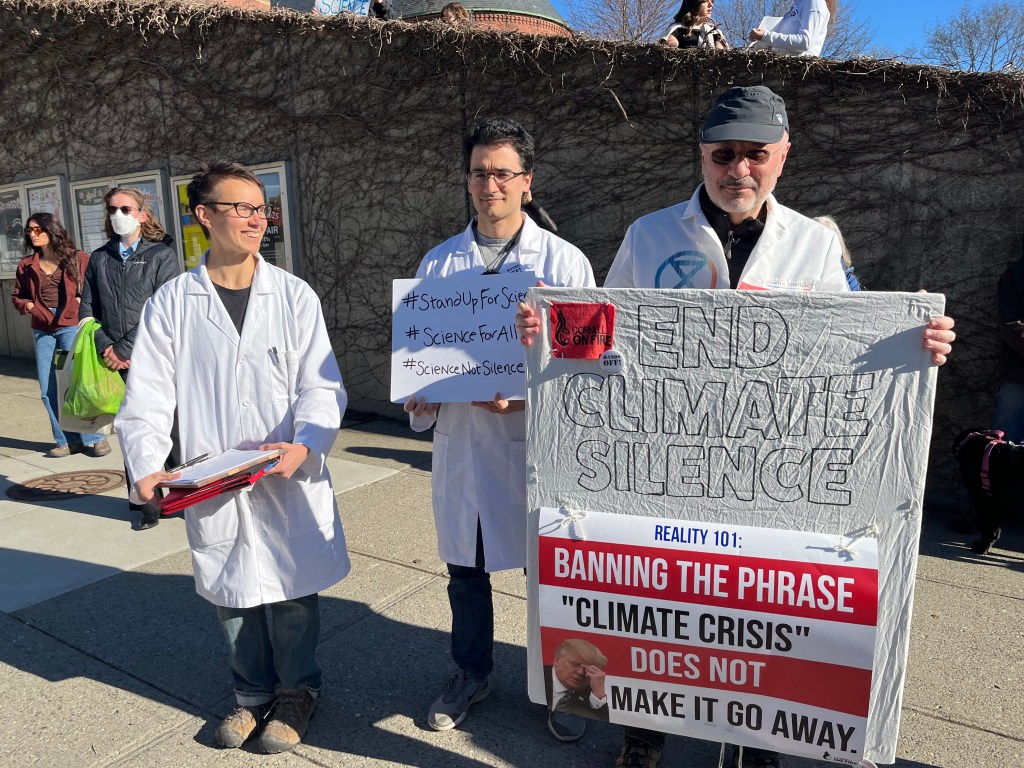
The April 17 National Day of Action had a great turnout at Cornell. We had speakers from across the university, in the sciences, humanities and social sciences, and the law school. We reprint some of these here.
I can’t tell you how heartening it is to see so many of you here today. And to know that we are just one of hundreds of rallies being held across the country as part of our national day of action.
In addition to being VP of the Cornell chapter of the AAUP, I’m also a political scientist who studies democratization and its reverse – the decline into authoritarianism. The attacks on higher education we’re seeing today are unprecedented in this country in their scope and severity. But they are not new. They are taken straight from the authoritarian playbook, from Russia, to Hungary, to Venezuela, to Turkey to Florida and now to the federal government. For many of our international colleagues, what they’re seeing now is terrifying but entirely familiar.
Authoritarians have always targeted universities. Why? I often hear that it’s because an uneducated population is a compliant population. I don’t think that’s quite right. I think there are two fundamental reasons:
(1) Attacks on universities are part of a broader assault on civil society. Suing CBS or ABC because of their coverage, or threatening to strip them of their broadcast license; going after law firms that worked for causes you dislike; threatening to punish businesses and organizations that step out line. Authoritarianism cannot tolerate a robust and independent civil society.
In today’s competitive authoritarianism, where elections still happen, rigging the playing field of civil society is essential to securing authoritarian rule. Universities are part of that.
(2) the second reason is more fundamental. The pretext for attacking universities has changed – anti-communism, anti-DEI, anti-woke – but the goal has stayed the same: to frame the University as an anomalous space outside the mainstream of American life, a topsy-turvy inversion of social hierarchies, where people are supposedly promoted on the basis of DEI rather than merit, where faculty can’t be fired and in fact are supposed to govern, where students are free to pursue their interests, to disobey, with consequences for sure but with consequences calibrated to the idea that the university exists precisely in order to give students and researchers and teachers the freedom necessary to discover.
The authoritarian story about universities works to naturalize and justify social hierarchies by creating a fictional version of the university where these are inverted.
But it isn’t even the knowledge that is most threatening to authoritarians. It’s the practices and protections of academic freedom – the institutional guarantees that allow us to pursue understanding and knowledge and to merit them for their own sake – that are threatening to them. And like all bullies, they threaten in turn that which threatens them.
So what’s our strategy? How do we respond?
Well, first off we can only respond collectively. What’s the song say? “For what force on earth is weaker than the feeble strength of one?” The first step, the one we’re taking today, is to come together and stand together!
This is not going to be easy. We’re here today in force. But what about tomorrow, when the Trump administration says that it might restore funding if this program is axed, if these students are expelled and deported, if these courses are shut down?
We know their strategy. It’s to divide us, or to keep us divided. They count on us turning against each other – treating this program as expendable, this person as disposable. They target the sciences, hopeful the sciences will turn on the humanities or that the humanities will look the other way. They target international students in order to silence all students. They hope that tenured faculty will see untenured colleagues – staff, RTE faculty – fired and turn away.
One of the big lies of authoritarianism is that they will oppress one without oppressing the other; that they can cut out one person – the immigrant, the climate scientist, the transgendered student – and leave the rest intact.
But it’s a lie.
“Any person any study” might be a motto or a principle. But it’s also a basic truth: you are not really free to study at all if you are not free to study all and to go wherever your studies take you.
So in coming together today, let us pledge to each other that no part of the University is expendable. No person at the University is disposable.
Second: The resistance to authoritarianism is going to come from below. And it’s going to work in part by making it clear to our organizations and institutions that we will not accept rolling over. We need to give our leadership and our allies the courage of their convictions.
So I want to thank Mike Kotlikoff for joining two national lawsuits. As he put it, Cornell cannot compromise on its core mission, “to do the most good,” or its core values of “any person any study” and academic freedom.
I want to thank him for throwing our hat in the ring. But it’s also going to take a lot more than those two hats!
University leadership has talked about how they want other universities, public universities in red states for example, to take the lead, because the ivies are too unpopular. Now, when those universities were under attack, the ivies said, well it wouldn’t do them any good for us, who are so unpopular, to come out in their defense.
We can’t accept that. If we won’t lead, no one will. Harvard has now set an example. And that’s really got to burn. But they do so after making huge concessions already, when they realized that no amount of conceding would provide protection. That lesson needed to be learned, but as of now there is no excuse for not having learned it.
Our leadership also includes the board of trustees. There’s been a lot of fear among the trustees, a belief that the university needs to get as close to Trump administration as possible, that doing so will protect us. But that’s not how this work. You cannot protect us by sacrificing who we are! You cannot save the University by demolishing it.
And our allies include New York State officials. Cornell is New York State’s public land grant college. It is one of its flagship institutions. It is state law that establishes the University Faculty at Cornell as the people responsible for setting education policy. It is state law that has established our majors and minors. It is state law that determines most of our diversity, equity, and inclusion policies. State law and authority are threatened by the federal assault on higher education and academic freedom. Cornell is one of the economic anchors of our region. And yet our state officials have so far been silent. They cannot be silent any longer.
Our potential allies include the Democratic Party in Congress. At some point the government will need to be funded – they should do everything in their power to demand a complete end of the assault on higher education and the reversal of those unlawful policies, as well as any stray lawful ones, that constitute this assault.
Finally – it is on us to hold the line. In our organizations, on campus and off; in our institutions of shared governance; in our committees; in our public and private advocacy.
When someone says, we’d better scrub our diversity, equity, and inclusion principles from the website. No. We hold the line.
When someone says, we should comply with this order, despite its being contrary to our values. No. We hold the line.
When the federal government sends its version of the demands it sent to Columbia or Harvard, demanding this or that program be dismantled or put under new leadership acceptable to the federal government. No. We hold the line.
That’s the strategy. We stand together in solidarity. We pledge to each other, that no part of the university is expendable, no person disposable. That we – and not would-be, and if we don’t stop them, will-be authoritarian bullies – determine the educational policy of the University. We support our leadership in fighting back, and push them to do more. We hold the line.
David Bateman is vice president of the Cornell chapter of the AAUP, and is an associate professor in the Government Department and in the Jeb E. Brooks School of Public Policy.
The April 17 National Day of Action had a great turnout at Cornell. We had speakers from across the university, in the sciences, humanities and social sciences, and the law school. We reprint some of these here.
My name is Lara Estroff. I am speaking to you today as a Materials Science and Engineering Professor.
For longer than any of us has been a student or a faculty member, there has been a thriving partnership between American universities and the United States government, committed to educating and training generations of scientists and engineers who have gone on to impactful careers that have made America a healthier, safer, and more technologically advanced society. This partnership has led to innovations that have resulted in faster, more compact consumer electronics, safer airplanes, life-saving vaccines, and more sustainable energy production.
This educational ecosystem is a shining example on the international stage and we attract students from all over the world who want to come and be trained at American universities.
Today, this partnership is threatened because one of the partners, the United States government, is threatening to withdraw. Disruption to this partnership will hurt not only current students and faculty at this and many other great universities, but it also threatens to damage our future as a country.
Now, I want to help us all understand how the money awarded to faculty in grants and contracts from federal funding agencies is actually used. The budgets for these grants have roughly three parts to them: funds to cover the educational costs for our graduate students; the materials and supplies associated with doing this cutting-edge research; and the indirect costs, called “facilities and administrative” or F&A costs, that go to the university.
These F&A costs are what we’ve heard about both in the news and in the emails from President Kotlikof and Provost Bala in regard to recent illegal actions taken by both the National Institutes of Health and the Department of Energy aimed at significantly reducing the F&A rate we can include in our budgets. Cornell has played an essential role in helping to halt both of these actions from being implemented through court-ordered injunctions, but the fight is not over!
At the end of World War II, when the partnership between universities and the government was forged, there was a realization that universities, as engines of innovation, were the ideal place to be training the scientists and engineers the US needed to have scientific and technological leadership in the world. But in order to do so, the infrastructure at these universities would need to be expanded to enable and support fundamental scientific and engineering research.
These may not be “sexy things” but they are incredibly important for doing our work: like laboratories with fume hoods and biosafety equipment, libraries with up-to-date and well-curated collections, cleanrooms for microelectronics fabrication like CNF, chemical and biological waste handling and disposal facilities, and state-of-the-art characterization facilities like CHESS. This infrastructure is expensive to develop and maintain; we’re talking about utility bills and technicians to service the equipment. We’re also talking about the administration costs related to ensuring research integrity and ethical performance of studies involving animals and humans, and much more. All of these costs are substantial and necessary; and require a continuous, rather than a one time, investment.
Without these funds coming into the university, our very mission is threatened. We will be unable to train the next generation of scientists and engineers who are going to be at the forefront of discovery in the coming decades; we will be unable to perform the fundamental research that will lead to innovative new therapies for disease, cleaner drinking water, and more sustainable construction materials for our built environment.
My colleagues and I are speaking with one voice. Some of us identify as Republicans, some as Independents, some as Democrats but we ALL recognize that standing up to the Trump administration is going to come with very real economic impact on our labs and our students. We are ready to take on these sacrifices to ensure that our academic freedoms, our ability to hire faculty and admit students according to our values and our educational mission, is not taken away and put under government oversight as we might expect from some other countries but NEVER in the United States of America! Cornell’s founding principal of “any person, any study” has endured and been a guiding light for 170 years. It is worth far more than $1 Billion. It will not be extinguished on our watch.
We are ready to fight and we are ready to make these sacrifices, but we need to do this together.
Lara Estroff is Chair of the Department of Materials Science and Engineering and Herbert Fisk Johnson Professor of Industrial Chemistry
 Cornell Chapter of the AAUP