National day of action speeches, David Bateman

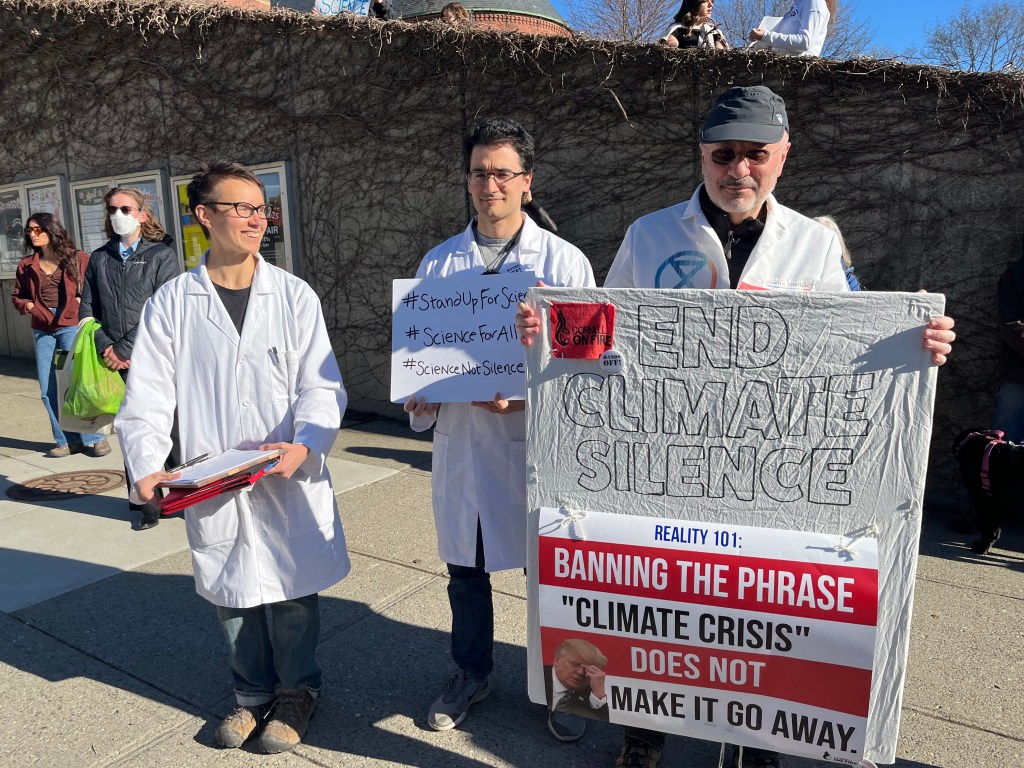
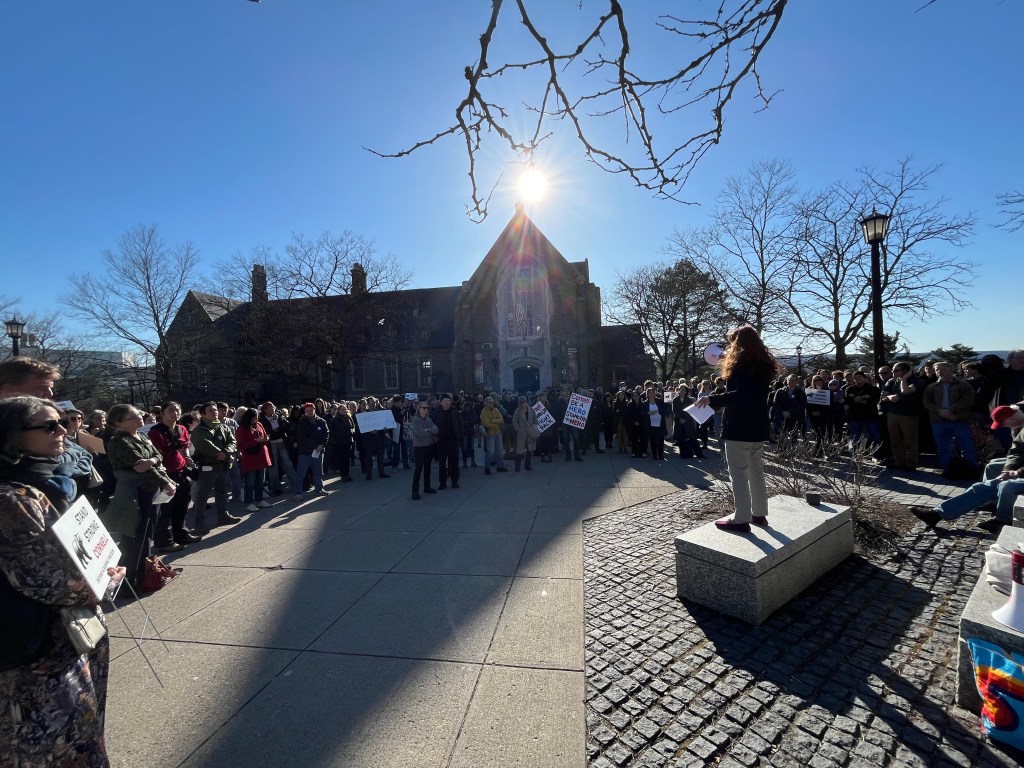
The April 17 National Day of Action had a great turnout at Cornell. We had speakers from across the university, in the sciences, humanities and social sciences, and the law school. We reprint some of these here.

I can’t tell you how heartening it is to see so many of you here today. And to know that we are just one of hundreds of rallies being held across the country as part of our national day of action.

In addition to being VP of the Cornell chapter of the AAUP, I’m also a political scientist who studies democratization and its reverse – the decline into authoritarianism. The attacks on higher education we’re seeing today are unprecedented in this country in their scope and severity. But they are not new. They are taken straight from the authoritarian playbook, from Russia, to Hungary, to Venezuela, to Turkey to Florida and now to the federal government. For many of our international colleagues, what they’re seeing now is terrifying but entirely familiar.  

Authoritarians have always targeted universities. Why? I often hear that it’s because an uneducated population is a compliant population. I don’t think that’s quite right. I think there are two fundamental reasons:

(1) Attacks on universities are part of a broader assault on civil society. Suing CBS or ABC because of their coverage, or threatening to strip them of their broadcast license; going after law firms that worked for causes you dislike; threatening to punish businesses and organizations that step out line. Authoritarianism cannot tolerate a robust and independent civil society.

In today’s competitive authoritarianism, where elections still happen, rigging the playing field of civil society is essential to securing authoritarian rule. Universities are part of that.

(2) the second reason is more fundamental. The pretext for attacking universities has changed – anti-communism, anti-DEI, anti-woke – but the goal has stayed the same: to frame the University as an anomalous space outside the mainstream of American life, a topsy-turvy inversion of social hierarchies, where people are supposedly promoted on the basis of DEI rather than merit, where faculty can’t be fired and in fact are supposed to govern, where students are free to pursue their interests, to disobey, with consequences for sure but with consequences calibrated to the idea that the university exists precisely in order to give students and researchers and teachers the freedom necessary to discover.

The authoritarian story about universities works to naturalize and justify social hierarchies by creating a fictional version of the university where these are inverted.

But it has this kernel of truth to it: The standards of excellence in a university are in many ways not the same as they are elsewhere. The standards are not how much money you make. They are not how well you convert knowledge into commercial applications. That might happen, might be encouraged, might be a good thing, but the goal is the knowledge first and foremost.

But it isn’t even the knowledge that is most threatening to authoritarians. It’s the practices and protections of academic freedom – the institutional guarantees that allow us to pursue understanding and knowledge and to merit them for their own sake – that are threatening to them. And like all bullies, they threaten in turn that which threatens them.

So what’s our strategy? How do we respond?

Well, first off we can only respond collectively. What’s the song say? “For what force on earth is weaker than the feeble strength of one?” The first step, the one we’re taking today, is to come together and stand together!

This is not going to be easy. We’re here today in force. But what about tomorrow, when the Trump administration says that it might restore funding if this program is axed, if these students are expelled and deported, if these courses are shut down?

We know their strategy. It’s to divide us, or to keep us divided. They count on us turning against each other – treating this program as expendable, this person as disposable. They target the sciences, hopeful the sciences will turn on the humanities or that the humanities will look the other way. They target international students in order to silence all students. They hope that tenured faculty will see untenured colleagues – staff, RTE faculty – fired and turn away.

One of the big lies of authoritarianism is that they will oppress one without oppressing the other; that they can cut out one person – the immigrant, the climate scientist, the transgendered student – and leave the rest intact.

But it’s a lie.

“Any person any study” might be a motto or a principle. But it’s also a basic truth: you are not really free to study at all if you are not free to study all and to go wherever your studies take you.

So in coming together today, let us pledge to each other that no part of the University is expendable. No person at the University is disposable.

Second: The resistance to authoritarianism is going to come from below. And it’s going to work in part by making it clear to our organizations and institutions that we will not accept rolling over. We need to give our leadership and our allies the courage of their convictions.

So I want to thank Mike Kotlikoff for joining two national lawsuits. As he put it, Cornell cannot compromise on its core mission, “to do the most good,” or its core values of “any person any study” and academic freedom.

I want to thank him for throwing our hat in the ring. But it’s also going to take a lot more than those two hats!

University leadership has talked about how they want other universities, public universities in red states for example, to take the lead, because the ivies are too unpopular. Now, when those universities were under attack, the ivies said, well it wouldn’t do them any good for us, who are so unpopular, to come out in their defense.

We can’t accept that. If we won’t lead, no one will. Harvard has now set an example. And that’s really got to burn. But they do so after making huge concessions already, when they realized that no amount of conceding would provide protection. That lesson needed to be learned, but as of now there is no excuse for not having learned it.  

Our leadership also includes the board of trustees. There’s been a lot of fear among the trustees, a belief that the university needs to get as close to Trump administration as possible, that doing so will protect us. But that’s not how this work. You cannot protect us by sacrificing who we are! You cannot save the University by demolishing it.

And our allies include New York State officials. Cornell is New York State’s public land grant college. It is one of its flagship institutions. It is state law that establishes the University Faculty at Cornell as the people responsible for setting education policy. It is state law that has established our majors and minors. It is state law that determines most of our diversity, equity, and inclusion policies. State law and authority are threatened by the federal assault on higher education and academic freedom. Cornell is one of the economic anchors of our region. And yet our state officials have so far been silent. They cannot be silent any longer.

Our potential allies include the Democratic Party in Congress. At some point the government will need to be funded – they should do everything in their power to demand a complete end of the assault on higher education and the reversal of those unlawful policies, as well as any stray lawful ones, that constitute this assault.

Finally – it is on us to hold the line. In our organizations, on campus and off; in our institutions of shared governance; in our committees; in our public and private advocacy.

When someone says, we’d better scrub our diversity, equity, and inclusion principles from the website. No. We hold the line.

When someone says, we should comply with this order, despite its being contrary to our values. No. We hold the line.

When the federal government sends its version of the demands it sent to Columbia or Harvard, demanding this or that program be dismantled or put under new leadership acceptable to the federal government. No. We hold the line.

That’s the strategy. We stand together in solidarity. We pledge to each other, that no part of the university is expendable, no person disposable. That we – and not would-be, and if we don’t stop them, will-be authoritarian bullies – determine the educational policy of the University. We support our leadership in fighting back, and push them to do more. We hold the line.

David Bateman is vice president of the Cornell chapter of the AAUP, and is an associate professor in the Government Department and in the Jeb E. Brooks School of Public Policy.
National day of action speeches, Lara Estroff

The April 17 National Day of Action had a great turnout at Cornell. We had speakers from across the university, in the sciences, humanities and social sciences, and the law school. We reprint some of these here.

My name is Lara Estroff.  I am speaking to you today as a Materials Science and Engineering Professor.

For longer than any of us has been a student or a faculty member, there has been a thriving partnership between American universities and the United States government, committed to educating and training generations of scientists and engineers who have gone on to impactful careers that have made America a healthier, safer, and more technologically advanced society. This partnership has led to innovations that have resulted in faster, more compact consumer electronics, safer airplanes, life-saving vaccines, and more sustainable energy production.

This educational ecosystem is a shining example on the international stage and we attract students from all over the world who want to come and be trained at American universities. 

Today, this partnership is threatened because one of the partners, the United States government, is threatening to withdraw. Disruption to this partnership will hurt not only current students and faculty at this and many other great universities, but it also threatens to damage our future as a country.

Now, I want to help us all understand how the money awarded to faculty in grants and contracts from federal funding agencies is actually used. The budgets for these grants have roughly three parts to them: funds to cover the educational costs for our graduate students; the materials and supplies associated with doing this cutting-edge research; and the indirect costs, called “facilities and administrative” or F&A costs, that go to the university.

These F&A costs are what we’ve heard about both in the news and in the emails from President Kotlikof and Provost Bala in regard to recent illegal actions taken by both the National Institutes of Health and the Department of Energy aimed at significantly reducing the F&A rate we can include in our budgets.  Cornell has played an essential role in helping to halt both of these actions from being implemented through court-ordered injunctions, but the fight is not over!

At the end of World War II, when the partnership between universities and the government was forged, there was a realization that universities, as engines of innovation, were the ideal place to be training the scientists and engineers the US needed to have scientific and technological leadership in the world. But in order to do so, the infrastructure at these universities would need to be expanded to enable and support fundamental scientific and engineering research.

These may not be “sexy things” but they are incredibly important for doing our work: like laboratories with fume hoods and biosafety equipment, libraries with up-to-date and well-curated collections, cleanrooms for microelectronics fabrication like CNF, chemical and biological waste handling and disposal facilities, and state-of-the-art characterization facilities like CHESS. This infrastructure is expensive to develop and maintain; we’re talking about utility bills and technicians to service the equipment.  We’re also talking about the administration costs related to ensuring research integrity and ethical performance of studies involving animals and humans, and much more. All of these costs are substantial and necessary; and require a continuous, rather than a one time, investment.

Without these funds coming into the university, our very mission is threatened. We will be unable to train the next generation of scientists and engineers who are going to be at the forefront of discovery in the coming decades; we will be unable to perform the fundamental research that will lead to innovative new therapies for disease, cleaner drinking water, and more sustainable construction materials for our built environment.

My colleagues and I are speaking with one voice. Some of us identify as Republicans, some as Independents, some as Democrats but we ALL recognize that standing up to the Trump administration is going to come with very real economic impact on our labs and our students.  We are ready to take on these sacrifices to ensure that our academic freedoms, our ability to hire faculty and admit students according to our values and our educational mission, is not taken away and put under government oversight as we might expect from some other countries but NEVER in the United States of America!  Cornell’s founding principal of “any person, any study” has endured and been a guiding light for 170 years.  It is worth far more than $1 Billion.  It will not be extinguished on our watch.

We are ready to fight and we are ready to make these sacrifices, but we need to do this together.

Lara Estroff is Chair of the Department of Materials Science and Engineering and Herbert Fisk Johnson Professor of Industrial Chemistry

National day of action speeches, Alyssa Apsel

The April 17 National Day of Action had a great turnout at Cornell. We had speakers from across the university, in the sciences, humanities and social sciences, and the law school. We reprint some of these here.

My name is Alyssa Apsel.

I am speaking to you today as an Electrical and Computer Engineering Professor.  Over in the Engineering school we take our roles as teachers and researchers very seriously.  Most of us would much rather be in the lab then out here talking about public policy.

We like to indoctrinate our students with things like

  • Kirchoff’s current laws
  • Digital Logic
  • Stochastic Processes
  • Computer Architecture
  • Charge transport models

As well as numerous other highly polarizing topics. 

So last week we, along with many other departments in the college of engineering received stop work orders on tens of millions of dollars of research contracts with the department of defense.  Across the college of Engineering, these contracts were awarded to conduct research on things including:

  • The design of advanced systems to control electromagnetic emission and absorption with implications for 1) stealth technology (radar detection) 2)thermal management (cooling) 3) efficient electricity generation from photovoltaics
  • Materials for high voltage and high temperature electronics to support things like propulsion systems.
  • Modeling of quantum mechanical systems to enable development of complex quantum computers.
  • Development of novel propellants for space crafts
  • As well as grants training workers to build satellites

Each of these research topics makes the US more secure, drives economic growth, and positions us in a research leadership position. 

It’s notable that US universities perform roughly half of the basic research done in the US.  Eliminating research from US universities will strictly weaken the US, both economically, and as a respected knowledge leader.  We will be less competitive globally and have less technology readiness.  This will probably make China and Russia quite happy. 

Beyond this, it is important to realize that University Research IS education. 

Our undergraduate programs can exist without federal research dollars, but graduate education in the sciences and engineering cannot and will not. 

Federal Contracts pay these students.  Period. 

This administration trying to wipe out both sciences today but also the next generation of scientists and decimate engineering research for decades to come. 

This is not hyperbole.  The top students will not stay in a country that does not welcome and support them.  They will go to Europe, or Asia, or whatever greener pasture welcomes them and the US will lose leadership status.

It really is that simple.

And on the topic of trade deficits, you know what our highest domestic export is? Education.  Not soybeans, or corn or natural gas, it’s education.  This is what these morons are trying to destroy. 

So, you wonder, given that we are teaching students math and science and physics, why would Trump and his cronies want to destroy us? 

Because truth is inherently political with this administration, and therefor dangerous.

If you are in the business of trying to convince people that up is down and left is right, you can’t have some professor showing up with data about gravity.

You can’t have an engineer showing that alternative power sources are actually feasible, or that lead in the pipes might cause disease and brain damage. You just can’t.  That’s dangerous.  They fear it.  So now they want us to be scared.   

So we can’t be.  We need to stand up, speak out, and organize.  They fear us because we have power.  We need to use that power. 

The folks attacking us, speak out of two sides of their mouths.  They hate us, but they also desperately want us to educate their kids.  That’s power.

They Ivy league and other large universities have a large base of alumni with resources.  They can work together and reconsider a joint plan of action.  That is power. 

We need to support each other because otherwise it does not end well for us.  What great research comes out of Hungary, I ask you?

Ordinarily and engineering prof like myself would much rather be in the lab then out here, but this, this is existential.  And I promise that like me, others are up for this fight.

Thank you. 

Alyssa Apsel is the Ellis L. Phillips Sr. Director of Electrical and Computer Engineering and IBM Professor of Engineering

National day of action speeches, Bruce Monger

The April 17 National Day of Action had a great turnout at Cornell. We had speakers from across the university, in the sciences, humanities and social sciences, and the law school. We reprint some of these here.

I need to begin my speech with a bit of a history lesson before I can deliver my punchline at the end of my speech that attempts to inspire you to raise your voices in support of Cornell resistance to the current government overreach. 

The last time I spoke (with a bullhorn) at a rally like this was back in 2001 when students from the KyotoNow student organization held rallies in front of Day Hall asking Cornell to demonstrate climate leadership by committing to reducing campus emissions consistent with the reductions prescribed in the Kyoto Protocol.  After 3 days of rallies, the Cornell administration finally agreed to the reductions.  Cornell was the first university in the country to make such a commitment!   Then in 2016, Cornell committed to go much further by developing a plan to make the campus carbon neutral by 2035.  That same year (2016), former President Hunter Rawlings, gave a speech at a Sustainable Campus Conference where he acknowledged the efforts of KyotoNow students who pushed him to try harder at reducing emissions.  The point here is that your voices and bottom-up social action can work to make a better world!

In the ocean class I cover threats of climate change and describe the extraordinary efforts in emission reduction that we must undertake to avoid the worst impacts.  I go on to tell students that every so often a generation is called upon to do something extraordinary.  I remind them that in 1940 a generation was called upon to rise up and fight a world war to save the democracies of the world. I then then tell them that a new generation – this generation — is now being called upon to do something even more extraordinary, to rise up and decarbonize the global energy system by mid-century to save all of humanity!!  

However, it now seems that before we can save all of humanity, we first need to save our own democracy.  The threats to Cornell and all US Universities being made by the current presidential administration represents the opening attacks on the freedoms of all Americans. 

I share Harvard President’s views that it would be unethical to let politics (right or left) dictate what, where, when and how a university teaches and does research.  It is government overreach, and we should stand together and resist it.

I tell ocean students that the historic times we live in today will test us all — both collectively and individually.   We can choose to shrink back and be small or we can choose to stand our ground in support of academic freedom and the values that underpin the freedom of all Americans.

What Can You Do?

Students who have taken my ocean class know that I am a big fan of writing letters!

  1. So, I encourage you to write or call government leaders and ask for their leadership and action to protect the freedoms of Cornell and other US Universities.
  2. And I especially encourage you to write letters to Cornell’s President and the Trustees in support of resisting the political pressure campaign against Cornell and other US universities.
  3. Tell them what it would mean to you personally if they chose to resist government overreach.   Tell them the pride you would feel for Cornell.
  4. I am sure Cornell leaders are under a lot of stress these days. And I think they could all use some notes of support.
  5. If you find it difficult to get your letter sent off, then send it to me.  I’ll print them all out and personally deliver them to the Cornell leadership.

I would like to conclude with a short story that will bring this speech full circle. About 4 years ago I gave a webinar talk for Cornell Alumni.  I talked about impacts of climate change on the ocean and concluded with a call for bottom-up action to demand leader act on climate change. And I included to KyotoNow story and how they push the Cornell Administration to try harder to reduce emissions that has led to the 2035 Climate Action Plan to make the Ithaca campus carbon neutral by 2035.  When I got home from giving my talk I had an email in my inbox from Abby.  In that email were these words:

“Thank you, Bruce. I just watched your webinar and was literally moved to tears. I was one of those Kyoto Now! students twenty years ago that you spoke about, and my name is at the base of the clocktower for the solar panels that were installed on Day Hall. I have watched with pride as Cornell has continued on the path that was set in motion that week you described and was touched that you talked about it.”

So, Abby acted when she saw the need – the historic moment! And because she acted, she now gets to cry sweet happy satisfied tears 20 years later!  We are once again at one of those important moments in history and I hope you all act now.  I hope 20 years from now you can all look back this moment in time and cry sweet happy satisfied tears because you acted when you saw the need!

Thank You!   

Bruce Monger is the Stephen H. Weiss Provost’s Teaching Fellow & Senior Lecturer, Earth and Atmospheric Sciences. College of Agriculture and Life Sciences

Contact list and example email / call language

We encourage every one looking to defend higher education to reach out to their representatives, senators, the governor, and other officials with authority over higher education in the United States and New York State.

We encourage you also to reach out to the leadership of Cornell University, including its president and the Board of Trustees. If you are faculty and have not yet signed the letter to the board of trustees, please do so.

For communications with university leadership and state and federal officials, here’s some potential language that might be helpful. This is only a suggestion, and it is always best when expressed in your own words with your own stories and perspectives behind it.

Dear —-:

The Trump administration is following the example of authoritarian regimes such as Russia, Hungary, and Turkey in attacking higher education. The goal is to suppress universities and colleges as sites of free expression and open inquiry, as part of a broader assault on civil society.

I am asking you to do everything in your power to resist this.

For University leadership [THIS LANGUAGE IS FROM HERE; see below for STATE OFFICIALS AND MEMBERS OF CONGRESS]:

  • Refuse to comply with illegal governmental overreach that undermines a university’s academic decision-making and self-governance
  • Defend freedom of inquiry by faculty and researchers from government censorship. 
  • Provide full legal representation for all illegally detained or targeted international students. 
  • Refuse to share student records or immigration information—to the extent that is legally permissible—with federal authorities seeking to suppress legal dissent. 
  • Engage local, regional, national and international media to expose these abuses of power. 
  • Lobby state legislators to enact protective laws safeguarding university autonomy and international members of our communities. 
  • Lobby our federal representatives to assert their constitutional powers to check transgressions by the executive branch. 
  • Engage alumni of the university to defend the institution that supported their life opportunities. 
  • Build alliances across red, blue, and purple states, across local and national unions, employers and other institutions that benefit from what universities contribute to society.
  • Publicly affirm that universities will not tolerate intimidation of students—domestic or international, Jewish, Palestinian or otherwise—exercising their free speech rights. 
  • Begin a campaign of joint op-eds signed by college presidents and chancellors to reaffirm our institutional commitments and defend our peers when they come under attack. 

For STATE OFFICIALS

In many areas, such as the lawless orders on diversity, equity, and inclusion, this is a direct assault on State authority, a demand that universities and colleges comply with illegal federal orders rather than with its own laws and policy. The example from Columbia University and others suggests that the Trump Administration is going to try to force changes to educational policy on these schools, which by New York State law is set by the University Faculty, the New York State Department of Education, and the New York State Board of Regents.

  • Join existing lawsuits, by the AAUP and others, against attacks on higher education. The State is directly impacted by the loss of revenue and by the undermining of State educational institutions
  • Examine any federally mandated changes to education policy for constitutionality and legality, and contest these through litigation
  • Remind educational institutions within the State of their legal obligations under State law, and inform them that if they were comply to federal demands in violation of State law or policy that State investigations would be opened. Our institutions will be less likely to comply if they recognize there are costs to doing so.
  • Help organized and join the proposed Mutual Academic Defense Compacts for public (land grant) universities and for private universities and colleges called on by UMass Amherst, Rutgers University, and others.
  • Explicitly denounce the Trump administration’s assault on higher education, and use whatever agenda setting, investigatory, lawmaking, or media platform influence you have to raise public awareness and opposition.

For MEMBERS OF CONGRESS

Federal assaults on universities and colleges are in clear violation of statutes, and are thus not only illegal or lawless but an attack on Congress’s legislative power and its role as the Article 1 branch established by the Constitution. Whether Republican or Democrat, all members of Congress have an interest in defending the law and Congress’s institutional status. The assaults on universities and colleges are thus not only an attack on a free society, but an unconstitutional disregard for the separation of powers.

I am asking you to do everything in your power to resist this:

  • Explicitly denounce the Trump administration’s assault on higher education, and use whatever agenda setting, investigatory, lawmaking, or media platform influence you have to raise public awareness and opposition.
  • Advance legislation – including by insertion into appropriations bills – prohibiting the Trump administration from canceling funding without following, to the letter, established statutory processes for doing so.
  • Vote against – and for Senators refuse to vote for cloture – any appropriations bill or increase to the debt ceiling that does not include a prohibition on the Trump administration’s lawless assault on higher education.

Opposing the authoritarian suppression of higher education will require all of our elected officials as well as our organizational leadership to draw the line and resist.

Contact List

Cornell President: (607) 255-5201 president@cornell.edu

Board of Trustees: (607) 255-5127 trustees@cornell.edu

Donica T. Varner – VP and General Counsel: (607) 255-5124 dtv26@cornell.edu

Governor Hochul: 518-474-8390 https://www.governor.ny.gov/content/governor-contact-form 

Betty A. Rosa, Commissioner of Education commissioner@nysed.gov

Board of Regents: Chancellor L.W. Young Regent.Young@nysed.gov,

Vice Chancellor J. Finn Regent.Finn@nysed.gov

Assembly Speaker Carl Heastie: 518-455-3791 speaker@assembly.state.ny.us

Senate Majority Leader Andrea Stewart-Cousins: 518-455-2585 MajorityLeaderCommunications@nysenate.gov

Assembly Standing Committee on Education Chair, Michael Benedetto 518-455-5296 benedettom@nyassembly.gov

Senate Committee on Education, Shelley B. Mayer 518-455-2031 smayer@nysenate.gov

Chuck Schumer (202) 224-6542 https://www.schumer.senate.gov/contact/message-chuck

Kirsten Gillibrand (202) 224-4451 https://www.gillibrand.senate.gov/contact/email-me/

Josh Riley (D-19) (202) 225-5441 https://riley.house.gov/contact/email-me

John Mannion (D-22) (202) 225-3701 https://mannion.house.gov/contact/email-me

Nick Langworthy (R-23) (202) 225-3161 https://langworthy.house.gov/contact

Claudia Tenney (R-24) (202) 225-3665 https://tenney.house.gov/contact

Pat Ryan (D-18) (202) 225-5614 https://patryan.house.gov/contact/email-me

Paul Tonko (D-20) (202) 225-5076 https://tonko.house.gov/contact/

Joseph Morelle (D-25) (202) 225-3615 https://morelleforms.house.gov/contact/?form=/contact/email-me