News and updates

What it is to break a strike

(This is a piece in the Cornell Daily Sun written by Cornell AAUP Chapter vice president David Bateman. It is not a chapter statement.)

Members of the Cornell community — custodians, groundskeepers, cooks, food service workers, greenhouse employees, gardeners, mechanics and others — are on strike. As the administration has acknowledged, the work these employees do is absolutely essential to the basic operation of the University. None of us can work, learn, research or teach in their absence.

Naturally, the strike has placed enormous stress on the institution. Basic work can’t be done.

And so the University leadership has asked us all to “step up” and pitch in, with emails from central administration, many colleges and other units giving guidelines on how all of us — students, faculty, staff, etc. — can do “our part.” To take extra responsibility to keep facilities clean. To volunteer for additional shifts. To serve food to students in dining halls. Retirees have been invited to fill in for former colleagues. The University leadership wants us to think of this as a noble, community effort to ensure that our students are fed, our facilities are clean and that Cornell continues to function despite the absence of its essential workers.

No doubt some of us have an inherent impulse to “step up” and do our part. This is natural, and the desire to help is a good one. We probably all believe that we should contribute when there is a crisis. And we hold in some contempt those who refuse to do so, who treat additional work produced by a crisis as someone else’s responsibility.

A labor strike, however, is one of those vital moments where a deeper logic is revealed. Strikes reveal the moral inadequacy of “community” as a guiding principle, how “stepping up” and “chipping in” can in fact be a cover for immoral actions.

A labor strike is not equivalent to a natural disaster or a crisis outside of our making. A strike reveals a profound conflict within our community, in this case one that is the result of the University’s own policies and choices. These include Cornell’s consistent refusal to recognize or pay for the considerable costs associated with its successes — a cost-of-living crisis in Ithaca and surrounding communities — and its desire to keep in its control as much of the value produced by its workforce as it can.

The workers represented by UAW 2300 have voted, democratically and overwhelmingly, to collectively withhold their labor until this conflict is resolved on terms that allow them to live and thrive.

The capacity to collectively withhold labor is the only real source of power workers have. In this context, “stepping up” or “doing our part” in the way that the University would like takes on a very different meaning. The workers have chosen to withhold their labor. The University would like us to replace it. This is not chipping in – it is choosing a side. When we replace striking labor, whether in their jobs or the work that they would be doing, we attack and undermine our friends and colleagues in their collective decisions and struggle. To “step up” in this context means taking the side of their employer, who wields enormous power over their lives and the lives of many others.

This is what it means to break a strike. This is what it means to scab.Subscribe to our daily newsletter!

“Community” can be a vague, empty term. We only imbue it with meaning through our actions. The University leadership has shown us its vision of “community.” It has shown this vision of community in its persistent refusal to recognize the value of its workers and the costs it imposes on Ithaca and neighboring communities. It has shown this vision of community in its misleading communications, wrongly implying that members of the Cornell community are outside employees of the UAW. It has shown this vision in spending what must be, after successive campaigns, millions of dollars to strike-breaking and union-busting firms, in order to undermine the democratic decisions of its employees. And it has shown this vision of community in its requests to employees to replace the work of their friends and colleagues.

The University appeals to our better natures, to our commitment to community, to conceal their real ask: to betray these friends and colleagues, at the moment when they are most in need of our support.

The Cornell leadership of the UAW 2300 chapter, by contrast, has shown a richer vision of what community needs and what it can be. They too appeal to our desire to help out, to step up. They have asked for solidarity, rather than to undermine each other.  To not replace striking labor or the work that they do. To show up on the picket line. To voice support. To demand that Cornell sign a fair contract. They have asked us to take the side of those members of our community fighting for a better life. They have asked us to stand with them. 

And in so doing, they are teaching us that real community can only be forged by a honest appraisal of injustice and unfairness, by a real understanding of the power that a few employers and institutional leaders hold over everyone else, and by a real commitment to challenging it.

David A. Bateman is an Associate Professor in the Department of Government. His research focuses broadly on democratic institutions; he is an expert in the American legislative branch. He can be reached at dab465@cornell.edu.

AAUP Chapter Statement on Bargaining between Cornell administration and UAW Local 2300

C:\Users\rll5\AppData\Local\Packages\Microsoft.Windows.Photos_8wekyb3d8bbwe\TempState\ShareServiceTempFolder\Cornell aaup logo.jpeg

August 14, 2024

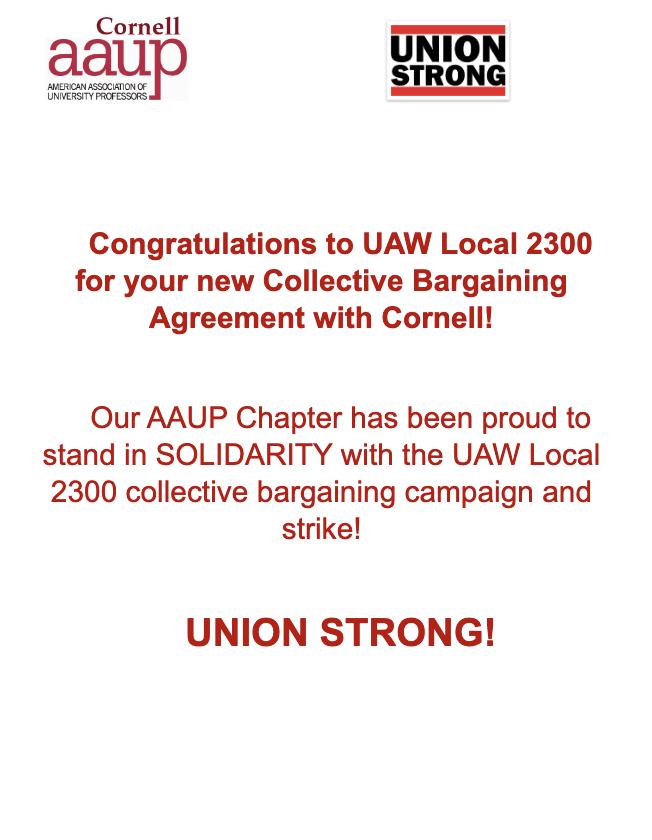
The Cornell University Chapter of the American Association of University Professors stands in solidarity with UAW Local 2300 and its fight to improve wages and working conditions for essential University workers. Our AAUP chapter, the union for tenure-track and non-tenure-track faculty, adjuncts, librarians, postdocs, and academic staff, urges the administration to agree to a fair contract in line with the workers’ demands. These include a pay increase to fairly compensate Cornell employees for their work, which is essential to running the University; bring wages in line with the cost of living; annual cost of living adjustments so that wage increases do not fall behind the cost of living; and greater allowances for parking and clothing to reduce costs and risks borne by the workers themselves.

Over the last several years, working conditions at Cornell have declined considerably, in line with the University’s broader failure to adequately compensate workers and to pay a fair share to the surrounding communities. Like any corporation, the University’s value is produced by its workers, and its operations generate burdens and costs for the community. For years now, University leadership has shifted costs onto workers through inadequate wages and benefits, just as it has chosen to shift costs onto Ithaca and neighboring communities by refusing to pay its fair share for public services.

Cornell creates employment opportunities in Ithaca and the surrounding region. At the same time, it has made living here increasingly unaffordable. This stems not only from its success in attracting workers and students to the region, but also from its refusal to pay its fair share to the city of Ithaca and neighboring communities through local property taxes or adequate payments in lieu of taxes. Cornell doesn’t pay, so everyone else has to pay more. 

As the cost of living increases, Cornell refuses to pay its workers a living wage, let alone a thriving wage. The MIT living wage calculator puts the living wage at $24.64 for a single person with no dependents and higher numbers for other household circumstances: $30.82 for two working parents with two children and $56.85 for a lone parent with two children. By contrast, the lowest entry-level wage in the recently expired contract is $19.17. Cornell’s offer of a 4% pay increase brings this up to $19.93, more than $4 below a living wage. (Cornell administrators have pointed out that this is above the current living wage as calculated by the ILR School’s Buffalo and Ithaca Co-Labs. However, if it were calculated today, it would be close to the MIT number, and when it is next re-calculated in February 2025 it will be even higher.)  

One result of wages not keeping up with the cost of living is that more and more workers commute from outside Ithaca and Tompkins County. This means that workers pay the cost of gas, wear and tear on vehicles, uncompensated commuting time, and parking. Along with these costs come risks. Workers who can’t get to work on time are vulnerable to disciplinary action, even if it is due to factors outside their control. Parking at Cornell is expensive and is assigned with little regard to need. Cornell could show respect for workers and reduce the daily stress facing workers by providing free parking near the place of work.    

We must not forget that UAW members bore the brunt of Cornell’s response to COVID-19. Many administrators, faculty and staff were able to work remotely, providing them with greater flexibility. Largely excluded were workers represented by the UAW, whose skills are essential to keeping the University’s physical infrastructure operational and who literally keep much of the University community housed and fed. These workers have been treated as a second-class workforce, last in line when benefits are doled out, first in line when cost reductions or new burdens are imposed. 

The University touts its public mission but refuses to behave as a good citizen. It privatizes the costs and burdens and claims for itself the successes and benefits. It rolls out the red-carpet for wealthy donors while stonewalling in bargaining and giving short-shrift to the people who make the University work. It is acting with the rapacity of a for-profit corporation sitting on $10 billion in wealth rather than with the public-mindedness and fairness required of a great public institution. 

The AAUP does not believe it remotely possible for the University to function if there were a strike. It would be equivalent to March 2020, when all operations had to cease and the University’s educational and research missions had to be put on pause. This would further corrode University life and community after several difficult years. The expertise of the UAW 2300 members cannot be replaced, and University administration knows it. 

The responsibility for averting a strike lies entirely with the administration. Faculty across the University know that without the work of UAW 2300 members, our teaching and research will grind to a halt. We will stand in solidarity with workers fighting for a living wage and fair working conditions. 

Cornell University Chapter of the AAUP Executive Committee: Risa Lieberwitz (President), David Bateman (Vice-President), Ian Greer (Secretary-Treasurer), Suman Seth (At-Large Executive Committee member), and Darlene Evans (At-Large Executive Committee member). 

Cornell Folding to Congress Is Nothing New

(The following is a piece in the Cornell Daily Sun by David Bateman. It is not a chapter statement)

In 1952, Pauli Murray, the pioneering scholar and civil rights activist, applied for a position at Cornell’s School of Industrial Labor Relations. It was the height of the Red Scare, when members of Congress — most infamously Senator Joe McCarthy and the House Un-American Activities Committee — targeted individuals for their political beliefs and associations.

Despite recommendations from Thurgood Marshall and Eleanor Roosevelt, the Cornell administration decided that there was insufficient proof that Murray was not a communist, and pointed to her “past associations” as cause for concern. They were likely referring to Murray’s involvement in civil rights and popular front organizations targeted by HUAC, but perhaps also Murray’s romantic relationships with women. These “associations” threatened to “place the University in a difficult situation.”

In denying her application, Cornell did not act at the direct behest of Congress. Its leadership acted instead out of worry, anticipating that by hiring Murray they might expose themselves to the scrutiny of the congressional witch-hunters. They hoped that by rejecting her application they might give “one hundred percent protection” to the University. Cornell was diminished by Murray’s absence.

Has seventy-two years been enough time for leadership at Cornell to learn that acquiescence to authoritarianism is no protection at all?

In March 2024, the House Ways and Means Committee, acting in the worst of Congress’s traditions, intervened in the internal community affairs of Cornell to explicitly attack the Coalition for Mutual Liberation (CML) and to demand Cornell “punish” these students. The House Education Committee had made similar demands of other universities, and would do so again as student encampments went up around the country.

Congressional committees are not toothless. But demands of its members do not gain force of law with their mere utterance. In this case, grandstanding by members of Congress serves their electoral interests while also coordinating a broader assault on universities. (As early as October 9, 2023, the House Republican leadership expressed its desire to use congressional resources to investigate college campuses.) Members of Congress are crafting a public narrative about what is happening on college campuses that aligns with far-right priorities to diminish universities’ significance as sites of free inquiry and public engagement.

Universities are not without legal or political resources of their own. The Cornell leadership could inform the Ways and Means Committee that intervention in code of conduct cases is inappropriate; or that under no circumstances will they discuss specific individuals or groups; they could even go on the offensive, and make the affirmative case that universities’ public mission requires protection against external interference, whether from donors or Congress.

Instead, administrations across the country seem to have bowed to pressure, resulting in the spectacle of university presidents throwing their students and employees under the media steamroller and a nationally synchronized assault on peacefully protesting students. No doubt, administrators at these universities were also hoping to provide their institutions “one hundred percent protection.”

What has the crackdown looked like at Cornell? Since October, but especially since the interim policy on expressive activity, events that touch on Palestine have been subjected to a level of scrutiny and administrative demands that borders on harassment. In contrast, in a misguided effort to showcase “viewpoint diversity,” the leadership invited the anti-Semitic and Islamophobic Ann Coulter to speak on how immigrants were a “conspiracy to end America” (and effectively enabled Cornell Police to remove and arrest a faculty member). On the day of the Ways and Means intervention, Cornell leadership ordered the arrest of students peaceful protesting in Day Hall. It later threatened students in the minimally-disruptive encampment with the same. (I suspect the discipline and good sense of the students, and opposition from faculty and persons within the administration, averted an escalation of police violence; so far as leadership self-restraint mattered, they deserve credit, though they could have committed to this from the outset.)Subscribe to our daily newsletter!

The leadership had already promised that protestors would be punished, and that repeat protestors would face escalating sanctions. This despite having no role in the normal process through which student code of conduct violations are determined and sanctioned. When it did issue suspensions, it circumvented the established process on spurious grounds, and the sanctions imposed carried consequences disproportionate to the alleged offense: the loss of a semester of work and tuition, and for international students the threat of losing their visa sponsorship.

Authoritarianism relies on vulnerability. Because of this, it targets the most vulnerable and inevitably undermines those institutions that reduce vulnerability, such as job security grounded in tenure or collective bargaining agreements or institutions of shared governance or due process rights. In its efforts to protect itself from Congress, the administration risks making congressional priorities its own and corroding those of our institutions and commitments that stand in the way.

The provost, now president, Mike Kotlikoff, warns faculty against speaking collectively, effectively telling them they should speak as isolated and vulnerable individuals before an administration that never doubts its own collective authority. Departments are told they should not post statements on matters of shared governance on their websites. The Faculty Senate is told that suspensions were not based on the interim policy even as the suspended students are told otherwise. Staff have been fired for private political speech, though transparently pretextual reasons are given. Tenured faculty are under threat of disciplinary action, including discharge. Untenured faculty are rightly worried that if they speak on controversial issues, they might be denied promotion and tenure or renewal. Not only might the leadership not defend them, it might denounce them and refuse to publicly oppose threats and harassment against them and their families.

What will happen next year? Will the administration attempt to subordinate independent voices such as the Cornell Daily Sun to administrative supervision? Will it try to enforce “viewpoint diversity” in academic programming or in classrooms? (Since what is relevant diversity is inherently a question of subject matter expertise, how could such policy not be an assault of academic freedom and integrity?) Will the committee tasked with revising the expressive activity policy be expanded to represent the expertise of the humanities and social sciences on issues of academic freedom, civil disobedience, and protest? Will it be independent from administration influence and its recommendations proceed through our shared governing bodies? What happens if a new US president comes to power, who has telegraphed his willingness to use the power of the federal government to punish students for their political positions?

Will the leadership of the University protect us, the University community? Or will it again conflate protection with compliance, facilitating authoritarian attacks on universities?

Because if Congress can demand the suppression of CML, it can demand the suppression of any group or individual on campus. So far as the University acquiesced to demands in this instance, for example by targeting CML members for suspension and promising punishment regardless of process, no one should feel secure that they would not do so in any other. If the administration was willing to undermine the perceived integrity of our disciplinary processes and circumvent shared governance to avert federal scrutiny, why should we trust them to adhere to any of our rules against any future authoritarian political leadership? And if the administration misled us about one policy, can it be trusted on any other?

If only Murray had been here to teach us.

Reflecting on Cornell’s explanation for rejecting her, Murray recalled that her most important “past association” was her family, who had “instilled in me a pride in my American heritage and a rebellion against injustice.”

As she wrote a beloved friend, “it took something like this to shock me out of my fear – the fear that has beset all liberals of late … [When I] decided to take on Cornell, I knew that I had taken a step forward. Would prefer not to fight—but the issues are so entertwined — race, sex, liberal academic tradition — each of us must hold his ground wherever he is.”

It is well-past time for Cornell – if not the leadership, then the rest of us — to hold its ground. Because the fight for higher education is just getting started.  

David A. Bateman is an Associate Professor in the Department of Government. His research focuses broadly on democratic institutions; he is an expert in the American legislative branch. He can be reached at dab465@cornell.edu.

CORNELL FACULTY CALL FOR SUSPENSIONS TO BE OVERTURNED

(The following was a collective statement endorsed by the Cornell Chapter of the AAUP as well as several university departments, committees, councils, and initiatives)

As Cornell faculty members, we are outraged by the university administration’s suspension of four students who participated in the Gaza Solidarity Encampment. The four suspended students have represented the encampment in conversations with the Administration. The Cornell administration has targeted these students specifically for being the alleged leaders of student protests. It has unilaterally and summarily imposed this retaliatory sanction without any due process. 

Cornell’s extreme punitive actions are a drastic escalation of the University’s ongoing repression of academic freedom and freedom of expression. The administration claims that they have taken disciplinary action against the students for violating Cornell’s Interim Expressive Activity policy against outdoor camping without prior registration. But this is simply a pretext for the real, disturbing reason for suspending the students – which is to intimidate all protestors and to reduce the four students to bargaining chips. As Provost Kotlikoff wrote today in an email message to a faculty member, “Please note that [student name]’s temporary suspensions can be lifted if the encampment is ended or moved, but that window is closing.” In other words, Provost Kotlikoff is treating the four students’ academic standing and enrollments as hostage to his political goal of minimizing the visibility and impact of student protests. His words place the responsibility for ending or moving the encampment onto four students who are not treated as individuals bearing rights, but are instrumentalized, deprived of fundamental rights, and denied lawful process. We call on the University to reverse its suspension of the four student protestors immediately and  to desist from these and other disciplinary measures. 

By imposing unwarranted and excessive sanctions on peaceful protesters, the Cornell administration has demonstrated that it is willing to sacrifice our students’ academic standing and futures in the name of political expediency. We will not go about business as usual when our students are deprived of rights, banished from the Cornell community, and their academic future put in danger. We will not stand by and allow administrators to threaten our students and suppress not only their right to freedom of expression and peaceful protest but the very foundation of our legal and moral obligations.

The University has abused its power under the Student Code of Conduct Procedures “to temporarily suspend” students “where immediate action is necessary to protect … the University community.” The peaceful encampment presents no danger to the University community. There is no violence or threat of violence, no unlawful harassment or discrimination, and no threatened harm to public health or safety. The University’s overreach  marks a disturbing signal that Cornell is falling in line with other university administrations across the United States who have taken violent actions against students, faculty, and staff. 

We demand an end to administrative violence. We demand that the Cornell administration reverse its decision to suspend students. We demand that the administration pledge to protect students’ rights to peacefully assemble. We demand that the administration pledge to keep law enforcement away from our students who are peacefully demonstrating, pursue no disciplinary action against these students, and agree to negotiate in order to find a way to meet their demands. The suspended students are the best of us. They have chosen to come to Cornell because, as one student put it, “I believed it was the best place for me to learn how I could most effectively use my voice to fight for justice.”