 Dear Cornell Faculty, Dear Cornell Faculty,In November 2023, Cornell graduate workers voted to form our union with a 96% supermajority. Together we empower ourselves to pursue world-class teaching and research without undue barriers. At a time when higher education is under threat, we stand united with our coworkers to fight for protections and benefits that all academic workers deserve and will support us as we build an academia in pursuit of scholarly excellence and innovation. A strong union contract upheld by a strong union is the most efficient way to achieve this goal. We began bargaining our first contract in March 2024. In the months that have followed, we have made significant progress at the bargaining table, coming to numerous tentative agreements on issues such as Health and Safety, and International Worker Rights. We are eager to work with the administration to finish negotiations quickly. On January 8th, we reached a key threshold, having signed 21 tentative agreements covering all but three key non-economic issues. In the same session, we also presented our economic proposals to the University, which include fair wage raises, improved healthcare access with dental and vision care, financial support for international graduate workers, and access to transit & parking facilities. Our proposals will bring protections and benefits on par with those already available to thousands of unionized graduate workers across the country, and provide an admissions package that is competitive with other unionized Ivy+ institutions. Despite this progress and a strong record of collaboration, we have recently noticed a significant shift in the attitude of the Cornell administration. This deterioration was evident at the start of our bargaining session on January 22nd, when the administration proposed substandard counters on fundamental protections including Union Security. When drafting counter proposals, Cornell often looks to peer institutions and other Cornell union contracts to see what standards exist. It was therefore surprising to hear the administration’s opposition to our Union Security proposal called Union Shop, which is the industry standard. While the administration was willing to agree to a fair share Union Shop article for the Weill Cornell Medicine Postdocs last May, they remain unwilling to do so with us. Additionally, the administration’s decision to cancel our February 4th bargaining session at the last minute – without offering any counters on our economic proposals or Union Shop and halting all progress toward a fair contract – is highly concerning. When we settle our union contract, it will dictate the terms and conditions of work for all graduate workers in the bargaining unit (TAs, RAs, GAs, and GRAs). Individual workers cannot opt out of our contract. However, only union members have the right to participate in the democratic decision-making of the union. Union Shop or universal membership is a contract provision rooted in the shared-governance model that ensures that every graduate worker whose working conditions are determined by our contract has a democratic voice in union decision-making. All graduate workers will receive the protections and benefits we win in our contract. Universal membership through Union Shop is the only way to ensure that all graduate workers who are impacted by our contract will have equal power to vote for our shared future and will contribute their fair share to our collective benefits as a condition of their employment. Union shop is common and practical. Every strong union has universal membership via Union Shop.Graduate worker unions at several Ivy+ institutions, including MIT, Northwestern, Stanford, Johns Hopkins, Brown, Dartmouth, and theUniversity of Chicago all have variations of Union Shop. All other union contracts at Cornell, including the Weill Cornell Medicine Postdocs Union, have Union Shop clauses (UAW 2300, Teamsters 317, BTC Maintenance Division, CWA, CPU, IUOE 158S, and SPFPA 502). In contrast, the administration’s position on Union Security for graduate workers at Cornell falls well short of industry standard and is out of place at a University where all other unions have Union Shop. Nevertheless, we remain committed to a spirit of collaboration at the table and to settling a contract that meets industry standard and graduate workers’ needs quickly. We are disappointed by signals that the Cornell administration does not share our commitment to resolving this contract and hope they will prioritize a fair and timely resolution. As scientists and scholars, we are tasked with solving the pressing issues of our generation, including those in climate change, reproductive rights, and public health. With freezes on NIH grant reviews and recent attempts to freeze all federal grants, many researchers are uncertain about the future of their work, and, for international workers, their ability to stay in the country. Attacks on science and higher education are likely to continue under the new administration. A strong union that protects graduate workers will only help the University weather these challenges. Our goal is to position graduate workers for success – to support them in producing the high quality research the university relies on for its prestige. Despite the uncertain political future, we want to fortify Cornell as an academic institution that can attract top quality talent, support them while they’re here, and prepare them for a future as leaders in their fields. Faculty and graduate workers have the same goals: protect us in our jobs so we can continue to do good work. We must stand united in our defense of our academic futures and the integrity of our University. For graduate workers at Cornell – like thousands of other unionized graduate workers across the country– this starts with universal membership in our union. Existing successful professional relationships between faculty, students, and graduate workers at Cornell will not be negatively affected by graduate workers in more precarious situations getting the support they need. We as graduate workers are directing our efforts at the Cornell administration, who have an opportunity to rise to the standards set by peer institutions and existing Cornell Union contracts. After nearly a year of bargaining and collaboration on 21 tentative agreements, the Cornell administration can choose to prioritize the future of our industry and of graduate workers, or continue to be outpaced by peer institutions and force an escalation towards a research and teaching strike on campus.Solidarity,CGSU-UE Bargaining Committee |
News and updates
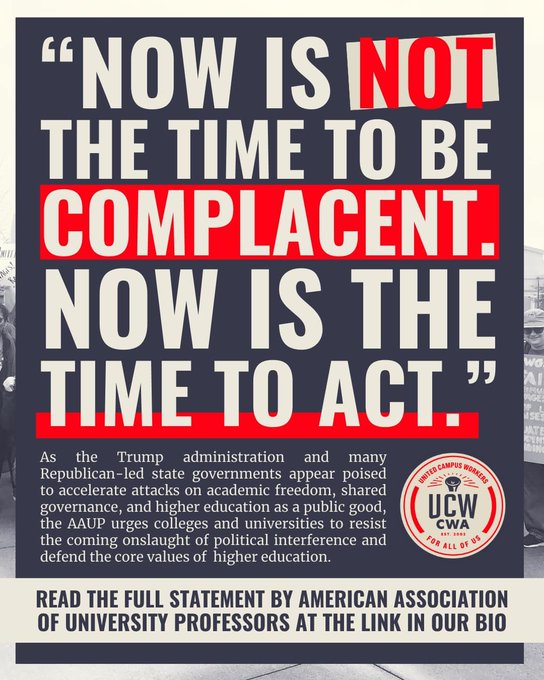
AAUP stands against anticipatory obedience
The linked statement, prepared by a joint subcommittee of the Association’s Committee on College and University Governance and Committee A on Academic Freedom and Tenure, was approved for publication by the parent committees in December 2024 and adopted by the Council in January 2025.
“The new administration’s agenda for higher education has been thoroughly prepared by a series of statewide legal assaults on public colleges and universities in North Carolina, Florida, Texas, and elsewhere, as well as by the high-profile congressional witch hunt that within the past year brought down the presidents of three Ivy League institutions. How should we respond? The University of Chicago’s 1967 Kalven Report, often cited as the source of calls for “institutional neutrality,” declares, “From time to time instances will arise in which the society, or segments of it, threaten the very mission of the university and its values of free inquiry. In such a crisis, it becomes the obligation of the university as an institution to oppose such measures and actively to defend its interests and its values.” This is undoubtedly such a time.”
More in the link!
AAUP litigation against unlawful executive orders
| Yesterday evening, the AAUP, along with the National Association of Diversity Officers in Higher Education and other partners filed a lawsuit to block Trump’s unlawful and unconstitutional DEI executive orders, which threaten academic freedom and access to higher education.The lawsuit, which can be read in full here, argues that Trump’s orders exceed his legal authority, are overly vague, and fail to define such terms as “DEI,” “equity,” and “illegal DEIA.” Without any definitive criteria or information, the orders open academic institutions to the risk of lawsuits for policies that promote diversity, equity, and inclusion.The AAUP has long advocated for diversity in higher education, including a diverse faculty and student body. The Association’s recent statement On Eliminating Discrimination and Achieving Equality in Higher Education focuses on diversity in faculty employment within an integrated understanding of how to move toward the broader goal of inclusion and equality in higher education. |
Statement by the Cornell AAUP Chapter Concerning Cornell Interim President Kotlikoff’s Interference with Academic Freedom
On Monday, November 11, an article appeared in the Jewish Telegraphic Agency article in which Cornell President Michael Kotlikoff was quoted denouncing a course scheduled to be taught by Cornell faculty member Eric Cheyfitz titled “Gaza, Indigeneity and Resistance”. Kotlikoff went further to question the integrity of the College of Agricultural and Life Sciences college curriculum committee for approving a course he objected to on transparently political grounds. And he asserted that he was actively working with colleagues in other departments to develop courses that will offer more “objective” courses on the topic. In other words, that conform to political criteria for how Palestine should be studied and taught (or not) at Cornell.
The story made national and international news, and Cheyfitz and his family began receiving hate mail including obscene calls for violence against his wife, children and grandchildren. Kotlikoff confirmed to Cheyfitz that he wrote the quotes attributed to him, but did not apologize.
Kotlikoff’s remarks are an egregious threat to bedrock principles of academic freedom, as well as Cornell’s commitment to “any person, any study.” They raise the specter of administrative interference in faculty control over curricular decisions and course instruction. They suggest that, despite repeated disavowals, the leadership of the University not only intends to scrutinize the in-class activities of Cornell faculty but is actively doing so where it is deemed politically desirable. Ultimately, his comments and actions threaten to degrade the quality of education students receive at Cornell and the ability of the University to be a leading center of research and knowledge production.
Kotlikoff’s remarks are not justifiable on the basis of his authority as University president. Faculty control over education is an essential component of academic freedom. This principle is manifested institutionally in several ways, from the authority of the University Faculty – delegated to the Faculty Senate – over general educational policy, to the authority of faculty of any particular college or school to determine its own courses of study, including the offering of any new majors or minors, to the faculty-led curricular or educational policy committees in each college or school, which determine the relevant educational policies and ensures new courses are compliant with state credit requirements or accreditation requirements.
As “chief educational officer,” the president is a member of the faculty and serves as an ex officio member of the more general bodies. But the president’s role is most extensive in matters of general educational policy, and most circumscribed or absent when it comes to specific courses or curricula. He does not serve on the educational policy or curricular committees tasked with making decisions about specific courses.
This reflects a recognition that while the president is charged with overseeing the general educational policy of the University, the office’s broad authority could pose a threat to academic freedom and the quality of education were it to be exercised at the level of curricular design or classroom instruction. As former President Pollack acknowledged in the context of proposals for new majors, such decisions are rightly “the domain of faculty members,” who are “in the best position to understand the disciplinary context and student interest.” This is even more true at the level of specific courses and classroom instruction.
Presidential authority is also limited by corresponding responsibilities to not only respect but jealously defend academic freedom. As Cornell’s policy commitments put it, a core pillar of academic freedom is “freedom of expression in the classroom on matters relevant to the subject and the purpose of the course and of choice of methods in classroom teaching.”
Academic freedom and faculty control over education requires that curricular and educational policy committees be protected against interference or administrative pressure, whether used to suppress a course or create new ones, and that they show broad deference to individual faculty’s expertise. While these committees might reasonably require some level of standardization in core courses, they generally avoid inspecting instructors’ substantive choices over readings or topics, especially in non-core courses. It is unreasonable to expect that any individual or committee could develop sufficient area expertise to evaluate the great diversity of courses taught at Cornell or in any school or college. More important, restraint and deference to faculty expertise is essential to realizing the public mission of universities as well as the specific values of “any person, any study” at Cornell. The members of the curricular and educational policy committees work carefully and in good faith to achieve this balance, ensuring that the overall curricular goals of the college or school are being achieved, that state and accreditation requirements are met, and that academic freedom in the offering and design of individual courses is respected and defended. Their efforts should not be carelessly dismissed by leadership, nor subjected to pressure from it.
Unlike Professor Cheyfitz, who has been teaching and publishing in this area for decades, President Kotlikoff is not an expert on Palestine/Israel and has no academic basis for objecting to the content of a course that has not yet been taught, in a field of study in which he has never been active, and in a discipline and program of which he is not a member. More important, his institutional responsibilities preclude him from weighing in on what courses individual instructors choose to teach or to question how they structure their syllabi, or on the decisions and deliberations of the relevant faculty committees that approve these courses. It is not just distasteful to second-guess and decry his faculty colleagues, whether individuals such as Cheyfitz or the responsible faculty bodies such as the curriculum committee. It is an abuse of his institutional position.
Most worrisome, Kotlikoff’s email is indicative of broader patterns that have become evident over the last year: the undermining of academic freedom and faculty control over education based on political litmus tests; and a reckless willingness to throw faculty, students, and staff under the bus when they become political targets, sharing information or administrative opinions about them with individuals or institutions with no legal right to know.
Nor are Kotlikoff’s comments excused by the context in which they were delivered. The quote was taken from an email sent to a Cornell faculty member, who then shared it with the press. But this was not private kvetching. The only reason Kotlikoff was asked his views is because he is president, and he must have reasonably expected to be read not as stating a personal opinion but as communicating University policy.
Kotlikoff’s email comes only a month after Cornell Vice President for University Relations Joel Malina was recorded, in a private meeting with parents, promising that in-class instruction activities for all faculty would be scrutinized. He singled out two faculty members in particular, whether because he had decided that their personal political positions were upsetting to some of the parents or because the administrators themselves had objected to the faculty members’ politics. In response to the ensuing outcry against this clear violation of academic freedom in teaching, Interim Provost John Siliciano repeatedly assured the governing bodies that Malina’s statements did not reflect Cornell policy. Kotlikoff’s email suggests, to the contrary, that such scrutiny is already occurring, or at least is when a course involves Israel/Palestine and is being taught by instructors who might present perspectives that do not conform to political criteria.
Last spring, we witnessed how Cornell would respond to politically motivated attacks on the University. Congressional committees demanded that specific student organizations be punished; Cornell immediately began changing its rules and processes to comply, in violation of established processes of shared governance. Where rule changes were insufficient, Cornell leadership pushed ahead and violated explicit constraints on the use of temporary suspensions, punishing students for whom there was not even a prima facia case for having violated any Cornell policy let alone rising to the level of immediate threat for which temporary suspensions are designed. Faculty and staff have been singled out for investigation and discipline based on their political views.
When remarks at an off-campus rally by a faculty member in the College of Arts and Sciences generated a political backlash, the president and provost announced that they found his views appalling and promised to scrutinize his teaching to find some plausible basis for revoking tenure. They announced this publicly, even as Kotlikoff – then provost – repeatedly assured faculty bodies in private closed sessions that he saw no possible reason to believe that the faculty member had violated Cornell policies. To politicians and other outside actors, they fueled the fire, contributing to the extraordinary wave of threats and harassment this faculty member and their family faced. They did this while privately assuring concerned faculty that there was nothing to worry about.
Political attacks on the University are only going to get worse. The question is how the University will respond. Will it continue to recklessly denounce faculty, students, and staff to anyone who asks, be they politicians, parents, donors, or any other random member of the community? Or will the University commit, through its policies and behaviors, to protecting academic freedom and free expression, to protecting shared governance, and to protecting faculty, students, and staff when acting on these principles?
Kotlikoff owes Cheyfitz an apology. He owes the University community something more. He owes us an affirmative, public commitment that going forward University leadership will not respond to inquiries about individual faculty, students, or staff with anything beyond a statement of Cornell’s commitment to academic freedom and free inquiry. If those inquiries are backed by legal authority, he owes us a commitment that the University will use its considerable legal and political resources to contest that authority. He owes us a commitment that he will cease recklessly participating, intentionally or not, in the politically motivated attacks against the University and academic freedom.
The Prosecution of Momodou Taal
The Cornell Daily Sun has a fantastic series on the prosecution of Momodou Taal, written by Cornell faculty (Paul Fleming, Tracy McNulty, and Mostafa Minawi) who have advised and observed the process first hand.
It is a chilling but essential read.
Part 1: “On Monday, Sept. 23 Momodou Taal, a graduate student and worker in Africana Studies, was notified by the Office of Student Conduct and Community Standards that he had been temporarily suspended from Cornell following alleged participation in a student protest that took place at a Sept. 18 career fair in the Statler Hotel…”
Part 2: “On March 29, Taal was called to a meeting by the OSCCS and was accompanied by a union representative, with Prof. McNulty serving as faculty support person. There he was presented with a complaint dated March 7 for alleged use of “amplified sound via a megaphone” in a protest at Duffield Hall that took place on Feb. 22 …. The OSCCS representative indicated that the complaint was based on a CUPD referral, but neither the referral nor any supporting evidence were presented.”
Part 3: On April 26 Taal received a message from Christina Liang, Director of the OSCCS, informing him that he was temporarily suspended, effectively immediately, for involvement on April 25 in an unauthorized encampment (the “Liberated Zone” encampment that was established on the Arts Quad on that day). Her letter noted that “the Interim Expressive Activities Policy, Section F, Outdoor Camping specifically provides that ‘[o]utdoor camping requires prior registration’. Notably, neither “amplified sound via a megaphone” (first complaint) nor “unauthorized camping” is a violation of the Student Code of Conduct. Instead the OSCCS charged and suspended Taal by applying a decree — the IEAP that the Cornell administration handed down on Jan. 24, 2024 without engaging in consultation with the Faculty Senate, University Assembly or other university governance bodies..”
Part 4: “On the morning of Sept. 23, Taal received a summons to a disciplinary meeting scheduled for noon that day… At that meeting Taal was presented with the formal complaint outlining three allegations relating to the Sept. 18 protest at Statler Hotel and the Carrier Ballroom… The written, formal complaint concluded by informing Taal that he was “temporarily suspended, effective immediately” and “withdrawn from all University privileges and services,” both of which remain “in effect until you receive further notice” from Cornell. Taal has acknowledged that he spoke at a protest outside the Statler Hotel which took place before the events described. However, Taal disputes most of the alleged conduct in the complaint. Importantly, the complaint does not even claim that Taal himself used force to gain entry into the building, that he acted in a violent or threatening way, or that he pushed police officers aside. The allegation that he entered “immediately behind” individuals who are alleged to have done so is vague and does not seem to be supported by video footage that has been widely circulated by media outlets. In any case, Taal has had no opportunity to see evidence supporting the allegations against him, much less the opportunity to present counter evidence or call witnesses who might corroborate his claims.”
Authored by:
Paul Fleming is a professor of Comparative Literature and German Studies in the College of Arts and Sciences. He served as Momodou Taal’s faculty advisor for his third complaint. He can be reached at paul.fleming@cornell.edu
Tracy McNulty is a professor of Comparative Literature and Romance Studies in the College of Arts and Sciences. She served as Momodou Taal’s faculty advisor for his first complaint. She can be reached at tkm9@cornell.edu
Mostafa Minawi is a professor of History in the College of Arts and Sciences. He served as Momodou Taal’s faculty advisor for his second complaint.. He can be reached at mm2492@cornell.edu
 Cornell Chapter of the AAUP