News and updates

AAUP wins in court!

A Legal Win for Members and Our Campuses and Communities

From https://www.aaup.org/news/win-aaup-higher-ed-and-our-communities

Last night, in a case in which the AAUP was a plaintiff, the US District Court for the District of Maryland granted a preliminary nationwide injunction on key parts of a pair of executive orders issued by President Trump. The orders broadly and in vague terms seek to end diversity, equity, inclusion, and accessibility mandates, policies, programs, preferences, and activities among federal government grantees and contractors, including virtually all colleges and universities.

In its decision, the court explicitly cited the evidence provided by courageous AAUP members when it found that there were “concrete actual injuries suffered by Plaintiffs and their members” as a result of the unlawful actions of the administration and that AAUP members and their institutions would “be forced to either restrict their legal activities and expression that are arguably related to DEI, or forgo federal funding altogether.”

The decision was in response to a suit filed by Democracy Forward on behalf of four organizations representing different affected groups: the AAUP (representing faculty members), the National Association of Diversity Officers in Higher Education (representing their diversity officer members), the City of Baltimore (representing a public sector grantee), and Restaurant Opportunities Centers United (representing a private sector grantee). We sought this temporary restraining order to prevent the Trump administration from using federal grants and contracts as leverage to force colleges and universities to end all diversity, equity, and inclusion programs, whether federally funded or not, and from terminating any “equity-related” federal grants or contracts.

As our brief explained, the orders are unconstitutional, usurping congressional power and violating First and Fifth Amendment rights. Absent preliminary relief, significant and irreparable harm would have been caused to our members, their students, and communities. Most importantly, the government could have used the threat of terminating billions of dollars of grants and contracts, as well as the threat of investigations and enforcement actions, to force faculty and universities to cease virtually all of their legally permissible work relating to diversity, equity, inclusion, and accessibility.

The AAUP’s membership includes many potentially affected faculty: those whose work focuses on Black studies; Latino studies; Asian studies; gender or sexual orientation identities; diversity, equity, and inclusion specifically; environmental justice; and other subject matter targeted by the president’s anti-DEIA executive orders. We also represent a significant number of members who focus on medical and other scientific research related to whether and how race and ethnicity affect health outcomes. Beyond AAUP members, students and communities would be harmed by the termination of the higher education grants: work on female reproductive health would be curtailed; assistance to help students with disabilities and from underrepresented populations graduate and find careers would be undermined; and efforts to strengthen research capacity at historically Black colleges and universities would be set back.

The judge noted that our lawsuit is likely to succeed on the claim that enforcement actions against companies and universities would violate constitutionally protected free speech and wrote: “That is textbook viewpoint-based discrimination . . . . The government’s threat of enforcement is not just targeted towards enforcement of federal law. Rather, the provision expressly targets, and threatens, the expression of views supportive of equity, diversity and inclusion.”

More information:

Day of action:  Mobilizing to defend education on March 4

https://www.aft.org/ProtectOurKids

The AAUP is supporting the American Federation of Teachers’ mobilization to defend education

The Trump administration wants to make painful cuts to education and healthcare in order to slash taxes for billionaires. The administration’s plan to “block grant” federal education programs and gut the U.S. Department of Education would rob 26 million students living in poverty of critical services and 7.5 million students with disabilities of special education support. It would eliminate career and technical education for 12 million students, threatening their future job opportunities. Slashing Medicaid and student loans could strip healthcare coverage from 10.3 million people and end access to student loans, making college unaffordable for another 10 million working-class families.

Join us on March 4 and stand up to protect our kids!

On Tuesday, March 4, educators, students, parents and community allies will stand up against assaults on public education and on opportunity for America’s youth. We are calling on lawmakers to strengthen, not undermine, our local public schools and the services they provide to children, families and communities.

By highlighting the harmful consequences of these attacks on public schools and students, we aim to build public pressure on policymakers and amplify the voices of those directly impacted.

We must:

  • Pressure decision-makers: Urge elected officials at both the federal and state levels to oppose cuts to federal funding and block grants, both of which will hurt kids.
  • Raise awareness: Educate the public about the devastating consequences of dismantling the Department of Education, gutting federal education funding and providing no-strings-attached block grants.
  • Mobilize support: Engage a broad coalition of stakeholders—including educators, students, parents and community members—to participate in actions nationwide.
  • Drive media coverage: Generate media attention through storytelling, coordinated events, rallies, etc.
  • Lift up our stories: Highlight how these cuts disproportionately harm vulnerable students, including those from underserved communities and students with disabilities.
  • Take action in our communities: Wage this fight in the communities where students will lose services they rely on, not just in Washington, D.C. 

Day of Action activities can include:

  1. Local and national events: Organize rallies, marches and teach-ins in key cities and communities on March 4. Partner with local organizations to host panels or town halls focused on the impact of federal education funding cuts.
  2. Advocacy and lobbying: Organize call-in days and email campaigns targeting legislators to urge them to oppose the Trump agenda that will hurt our public schools and communities. Provide participants with scripts and talking points for contacting their representatives.
  3. Story collection and amplification: Collect and share real-life stories from educators, students and parents showcasing the tangible harm cuts to services and supports they rely on will cause. Use videos, blogs and social media to amplify their voices.
  4. Media outreach: Conduct interviews with local media outlets and adapt a sample press release and op-ed featuring impacted individuals.
  5. Digital mobilization: Launch a robust social media campaign with shareable graphics, infographics and videos using the hashtag #ProtectOurKids to drive engagement and awareness.

Resources from the Center for the Defense of Academic Freedom – AAUP

The director for the AAUP Center for the Defense of Academic Freedom, Isaac Kamola, is sharing resources for the fight:

The cruelty of the new administration’s attack on democracy and higher education has been staggering, from arbitrary cuts to research funding to the malicious misrepresentation of our work to Linda McMahon’s unwillingness to say that teaching African American history is still legal.

Fighting back requires understanding the threats we face as well as developing the tools necessary to convey the value of higher education to a wide audience. In this context, the AAUP’s Center for the Defense of Academic Freedom has recently published a number of resources that we hope will be useful in the fight ahead:

  • Academic Freedom on the Line is a weekly Substack edited by CDAF fellow John Warner. This newsletter examines questions around academic freedom, its role in a democratic society, and what is lost when academic communities face politicized attacks on institutional autonomy and shared governance. Check out posts on CDAF’s mission, the risks of obeying in advance, advice for college and university boards, and reflections on the recent “Dear Colleague” letter.
  • Executive Power Watch is a series of short handouts that offer analyses of education-related executive actions, including executive orders that target diversity, equity, and inclusion; weaponize antisemitism; and target transgender, intersex, and nonbinary people. These resources offer concrete suggestions about what you can do to fight back.
  • Action Reports are short studies that offer concrete analysis and guidance on how to respond to particular threats to academic freedom, such as

Future Action Reports will examine the American Council of Trustees and Alumni and strategies for using collective bargaining agreements to resist post-tenure review laws.

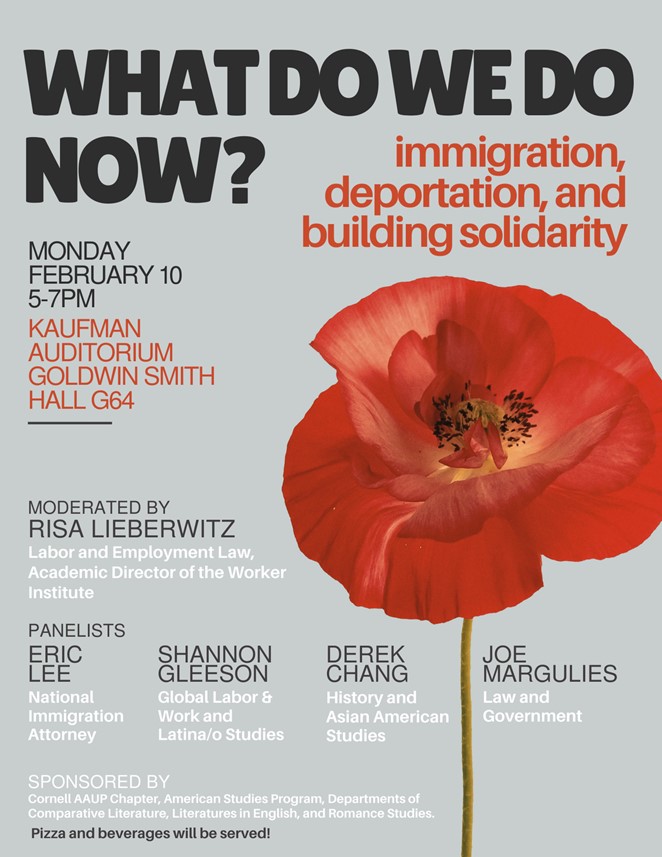
What Do We Do Now? Immigration, Deportation, and Building Solidarity

Panel discussion, sponsored by the Cornell AAUP Chapter, American Studies Program, Departments of Comparative Literature, Romance Studies, and Literatures in English

The Trump administration’s recent executive orders target both undocumented and international students, workers, and scholars and threaten them with deportation as part of an unprecedented scale of racist and xenophobic policies. In this moment of overwhelming repression, we come together as a community and affirm our solidarity. This panel asks: how do we continue to foster critical thought, both intellectually and politically? How do we build a collective movement of resistance? What lessons from the past are relevant today? 

Where: Kaufman Auditorium, Goldwin Smith Hall G64

When: 5-7 pm Monday, February 10

Who: Panelists are Eric Lee, National Immigration Attorney; Derek Chang, History and Asian American Studies; Joe Margulies, Law and Government; Shannon Gleeson, Global Labor & Work and Latina/o Studies

Moderated by Risa Lieberwitz, Labor and Employment Law, Academic Director of the Worker Institute

Pizza and beverages will be served!

From the CGSU-UE bargaining committee to Cornell faculty

Dear Cornell Faculty,

In November 2023, Cornell graduate workers voted to form our union with a 96% supermajority. Together we empower ourselves to pursue world-class teaching and research without undue barriers. At a time when higher education is under threat, we stand united with our coworkers to fight for protections and benefits that all academic workers deserve and will support us as we build an academia in pursuit of scholarly excellence and innovation. A strong union contract upheld by a strong union is the most efficient way to achieve this goal.

We began bargaining our first contract in March 2024. In the months that have followed, we have made significant progress at the bargaining table, coming to numerous tentative agreements on issues such as Health and Safety, and International Worker Rights. We are eager to work with the administration to finish negotiations quickly. On January 8th, we reached a key threshold, having signed 21 tentative agreements covering all but three key non-economic issues. In the same session, we also presented our economic proposals to the University, which include fair wage raises, improved healthcare access with dental and vision care, financial support for international graduate workers, and access to transit & parking facilities. Our proposals will bring protections and benefits on par with those already available to thousands of unionized graduate workers across the country, and provide an admissions package that is competitive with other unionized Ivy+ institutions.

Despite this progress and a strong record of collaboration, we have recently noticed a significant shift in the attitude of the Cornell administration. This deterioration was evident at the start of our bargaining session on January 22nd, when the administration proposed substandard counters on fundamental protections including Union Security. When drafting counter proposals, Cornell often looks to peer institutions and other Cornell union contracts to see what standards exist. It was therefore surprising to hear the administration’s opposition to our Union Security proposal called Union Shop, which is the industry standard. While the administration was willing to agree to a fair share Union Shop article for the Weill Cornell Medicine Postdocs last May, they remain unwilling to do so with us. Additionally, the administration’s decision to cancel our February 4th bargaining session at the last minute – without offering any counters on our economic proposals or Union Shop and halting all progress toward a fair contract – is highly concerning.

When we settle our union contract, it will dictate the terms and conditions of work for all graduate workers in the bargaining unit (TAs, RAs, GAs, and GRAs). Individual workers cannot opt out of our contract. However, only union members have the right to participate in the democratic decision-making of the union. Union Shop or universal membership is a contract provision rooted in the shared-governance model that ensures that every graduate worker whose working conditions are determined by our contract has a democratic voice in union decision-making. All graduate workers will receive the protections and benefits we win in our contract. Universal membership through Union Shop is the only way to ensure that all graduate workers who are impacted by our contract will have equal power to vote for our shared future and will contribute their fair share to our collective benefits as a condition of their employment.

Union shop is common and practical. Every strong union has universal membership via Union Shop.Graduate worker unions at several Ivy+ institutions, including MITNorthwesternStanfordJohns HopkinsBrownDartmouthand theUniversity of Chicago all have variations of Union Shop. All other union contracts at Cornell, including the Weill Cornell Medicine Postdocs Union, have Union Shop clauses (UAW 2300, Teamsters 317, BTC Maintenance Division, CWA, CPU, IUOE 158S, and SPFPA 502). In contrast, the administration’s position on Union Security for graduate workers at Cornell falls well short of industry standard and is out of place at a University where all other unions have Union Shop.

Nevertheless, we remain committed to a spirit of collaboration at the table and to settling a contract that meets industry standard and graduate workers’ needs quickly. We are disappointed by signals that the Cornell administration does not share our commitment to resolving this contract and hope they will prioritize a fair and timely resolution.

As scientists and scholars, we are tasked with solving the pressing issues of our generation, including those in climate change, reproductive rights, and public health. With freezes on NIH grant reviews and recent attempts to freeze all federal grants, many researchers are uncertain about the future of their work, and, for international workers, their ability to stay in the country. Attacks on science and higher education are likely to continue under the new administration. A strong union that protects graduate workers will only help the University weather these challenges.

Our goal is to position graduate workers for success – to support them in producing the high quality research the university relies on for its prestige. Despite the uncertain political future, we want to fortify Cornell as an academic institution that can attract top quality talent, support them while they’re here, and prepare them for a future as leaders in their fields. Faculty and graduate workers have the same goals: protect us in our jobs so we can continue to do good work.

We must stand united in our defense of our academic futures and the integrity of our University. For graduate workers at Cornell – like thousands of other unionized graduate workers across the country– this starts with universal membership in our union. Existing successful professional relationships between faculty, students, and graduate workers at Cornell will not be negatively affected by graduate workers in more precarious situations getting the support they need. We as graduate workers are directing our efforts at the Cornell administration, who have an opportunity to rise to the standards set by peer institutions and existing Cornell Union contracts.

After nearly a year of bargaining and collaboration on 21 tentative agreements, the Cornell administration can choose to prioritize the future of our industry and of graduate workers, or continue to be outpaced by peer institutions and force an escalation towards a research and teaching strike on campus.Solidarity,CGSU-UE Bargaining Committee