National day of action speeches, Sandra Babcock

The April 17 National Day of Action had a great turnout at Cornell. We had speakers from across the university, in the sciences, humanities and social sciences, and the law school. We reprint some of these here.
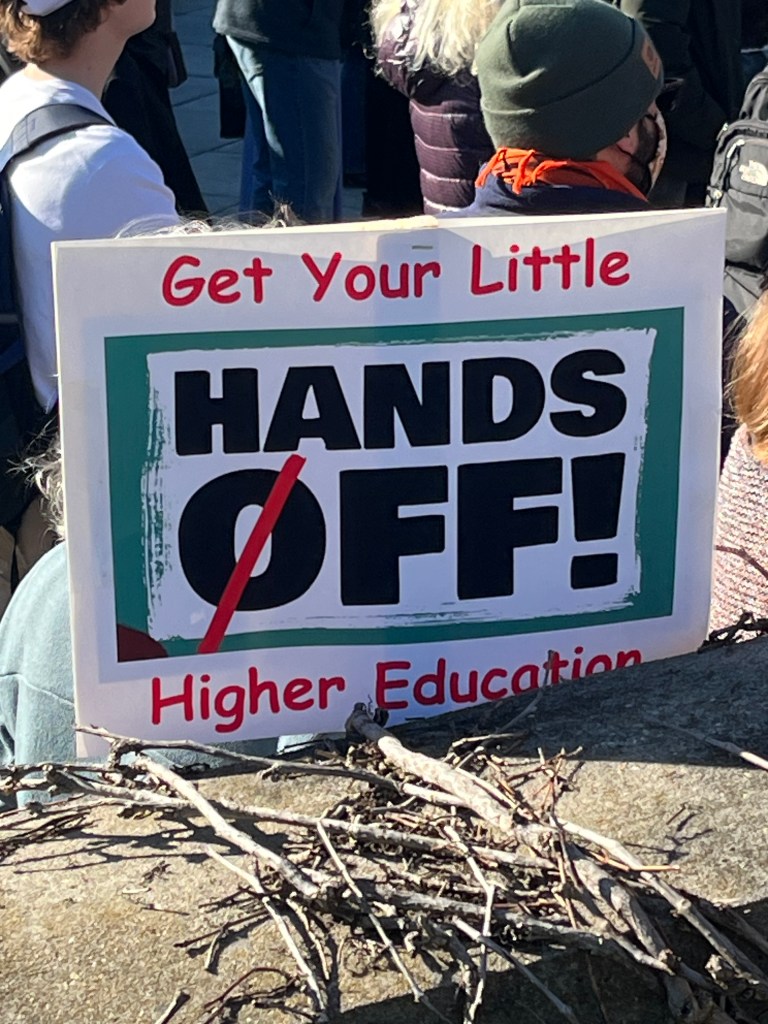
This demonstration is a call to arms for the defense of higher education.

We are calling on Cornell to STAND UP AND FIGHT BACK, because higher education is worth defending.

There are a lot of false narratives circulating these days about higher education.

People say our students are either privileged puffballs or left-wing lunatics.

People say that faculty are either cocooned in ivory towers where they are completely untethered to the day-to-day concerns of ordinary folks, or they are scheming to indoctrinate our students in dangerous and subversive ideologies.

And recently, people have been saying that universities are hotbeds of anti-semitism.

These are all false narratives, and those who promote them are profoundly ignorant of who we are, what we do, and how we do it.

Let’s start with the students.  Our 26,000 students are incredibly diverse. They don’t come to us as empty vessels waiting for us to pour our ideological perspectives into their waiting brains. They are smart and they know how to think for themselves. Many of them have experienced economic precarity, others have undergone tremendous hardships, and yes, some come from more elite backgrounds. But whatever their backgrounds, the vast majority are thoughtful and eager to learn.

Cornell’s best students are also deeply principled and empathetic. They care about the world we live in. They care about the suffering of people in Darfur, in Ukraine, in Xinjiang China, and in Gaza.  And when they speak out about injustice, and when they make us uncomfortable with their demands, they are doing precisely what students have done for generations.

Our student protestors are human rights defenders who deserve our protection and support under international human rights law. The UN expert on the Rights of Freedom of Peaceful Assembly and of Association wrote recently that the university Palestinian solidarity protest movement demonstrated “the profound sensibility, civic responsibility, and creative potential of youth.” And the UN expert on human rights defenders has pointed out that youth and children “are at the forefront, and often the main driving force, of societal, economic and political change.” We must forcefully resist the false narrative that student protestors are criminals or terrorists—and University leadership must likewise resist the pressure to subject them to ever-more severe disciplinary measures that jeopardize their safety and their futures.

As for our faculty – let’s talk about some of the life-saving, transformative work that we’re doing in communities in New York, around the United States, and throughout the world. Many of our faculty may lose their jobs under the government’s threatened funding freeze.

At the Cornell Medical School, the faculty who are most vulnerable to job cuts carry out life changing medical research, take care of you and your families when you are sick, and educate future generations of researchers and doctors so that someone will be around to take care of your children and grandchildren.

At Cornell Law School, the most vulnerable faculty are those who, together with law students, are helping low-income taxpayers in rural Alaska fill out their tax returns so they can receive government refunds, or those who are training students to obtain justice for women in the military who are sexual assault survivors. The most vulnerable faculty at the Cornell School of Agriculture and Life Sciences are involved in educating small farmers in Central New York about how they can mitigate the impact of climate change and grow crops that supply regional food systems.

These are just a few examples of what we call RTE faculty – faculty who lack tenure, who work on short-term contracts with little job protection. There are over 1,300 of us working across Cornell. Our work is more vital than ever as government programs are cut and communities lose access to resources. But without job security, we—together with the staff who keep many University programs running—will be the first casualties of federal funding cuts. We need greater pathways to tenure and more job security—and for that, we need the support of our tenured colleagues and the administration. This is a moment where we should stand together to strengthen our institution, not weaken it.

When we stand together, we are STRONG.

When we read about “Cornell University” in the news, those stories are often referring to the actions of our President and Cornell’s Board of Trustees. But they are not Cornell. We who are standing here today are Cornell.

Our librarians ARE CORNELL.

Our staff ARE CORNELL.

Our faculty ARE CORNELL.

Our extension workers ARE CORNELL.

Our students ARE CORNELL.

And we want the Board of Trustees and the President to HEAR OUR VOICE. We are Cornell, and we will not be silenced.

Sandra Babcock is Clinical Professor of Law, specializing in international human rights litigation, access to justice, death penalty defense, international gender rights, and the application of international law in US courts.
National day of action speeches, Bruce Monger

The April 17 National Day of Action had a great turnout at Cornell. We had speakers from across the university, in the sciences, humanities and social sciences, and the law school. We reprint some of these here.

I need to begin my speech with a bit of a history lesson before I can deliver my punchline at the end of my speech that attempts to inspire you to raise your voices in support of Cornell resistance to the current government overreach. 

The last time I spoke (with a bullhorn) at a rally like this was back in 2001 when students from the KyotoNow student organization held rallies in front of Day Hall asking Cornell to demonstrate climate leadership by committing to reducing campus emissions consistent with the reductions prescribed in the Kyoto Protocol.  After 3 days of rallies, the Cornell administration finally agreed to the reductions.  Cornell was the first university in the country to make such a commitment!   Then in 2016, Cornell committed to go much further by developing a plan to make the campus carbon neutral by 2035.  That same year (2016), former President Hunter Rawlings, gave a speech at a Sustainable Campus Conference where he acknowledged the efforts of KyotoNow students who pushed him to try harder at reducing emissions.  The point here is that your voices and bottom-up social action can work to make a better world!

In the ocean class I cover threats of climate change and describe the extraordinary efforts in emission reduction that we must undertake to avoid the worst impacts.  I go on to tell students that every so often a generation is called upon to do something extraordinary.  I remind them that in 1940 a generation was called upon to rise up and fight a world war to save the democracies of the world. I then then tell them that a new generation – this generation — is now being called upon to do something even more extraordinary, to rise up and decarbonize the global energy system by mid-century to save all of humanity!!  

However, it now seems that before we can save all of humanity, we first need to save our own democracy.  The threats to Cornell and all US Universities being made by the current presidential administration represents the opening attacks on the freedoms of all Americans. 

I share Harvard President’s views that it would be unethical to let politics (right or left) dictate what, where, when and how a university teaches and does research.  It is government overreach, and we should stand together and resist it.

I tell ocean students that the historic times we live in today will test us all — both collectively and individually.   We can choose to shrink back and be small or we can choose to stand our ground in support of academic freedom and the values that underpin the freedom of all Americans.

What Can You Do?

Students who have taken my ocean class know that I am a big fan of writing letters!

  1. So, I encourage you to write or call government leaders and ask for their leadership and action to protect the freedoms of Cornell and other US Universities.
  2. And I especially encourage you to write letters to Cornell’s President and the Trustees in support of resisting the political pressure campaign against Cornell and other US universities.
  3. Tell them what it would mean to you personally if they chose to resist government overreach.   Tell them the pride you would feel for Cornell.
  4. I am sure Cornell leaders are under a lot of stress these days. And I think they could all use some notes of support.
  5. If you find it difficult to get your letter sent off, then send it to me.  I’ll print them all out and personally deliver them to the Cornell leadership.

I would like to conclude with a short story that will bring this speech full circle. About 4 years ago I gave a webinar talk for Cornell Alumni.  I talked about impacts of climate change on the ocean and concluded with a call for bottom-up action to demand leader act on climate change. And I included to KyotoNow story and how they push the Cornell Administration to try harder to reduce emissions that has led to the 2035 Climate Action Plan to make the Ithaca campus carbon neutral by 2035.  When I got home from giving my talk I had an email in my inbox from Abby.  In that email were these words:

“Thank you, Bruce. I just watched your webinar and was literally moved to tears. I was one of those Kyoto Now! students twenty years ago that you spoke about, and my name is at the base of the clocktower for the solar panels that were installed on Day Hall. I have watched with pride as Cornell has continued on the path that was set in motion that week you described and was touched that you talked about it.”

So, Abby acted when she saw the need – the historic moment! And because she acted, she now gets to cry sweet happy satisfied tears 20 years later!  We are once again at one of those important moments in history and I hope you all act now.  I hope 20 years from now you can all look back this moment in time and cry sweet happy satisfied tears because you acted when you saw the need!

Thank You!   

Bruce Monger is the Stephen H. Weiss Provost’s Teaching Fellow & Senior Lecturer, Earth and Atmospheric Sciences. College of Agriculture and Life Sciences

Contact list and example email / call language

We encourage every one looking to defend higher education to reach out to their representatives, senators, the governor, and other officials with authority over higher education in the United States and New York State.

We encourage you also to reach out to the leadership of Cornell University, including its president and the Board of Trustees. If you are faculty and have not yet signed the letter to the board of trustees, please do so.

For communications with university leadership and state and federal officials, here’s some potential language that might be helpful. This is only a suggestion, and it is always best when expressed in your own words with your own stories and perspectives behind it.

Dear —-:

The Trump administration is following the example of authoritarian regimes such as Russia, Hungary, and Turkey in attacking higher education. The goal is to suppress universities and colleges as sites of free expression and open inquiry, as part of a broader assault on civil society.

I am asking you to do everything in your power to resist this.

For University leadership [THIS LANGUAGE IS FROM HERE; see below for STATE OFFICIALS AND MEMBERS OF CONGRESS]:

  • Refuse to comply with illegal governmental overreach that undermines a university’s academic decision-making and self-governance
  • Defend freedom of inquiry by faculty and researchers from government censorship. 
  • Provide full legal representation for all illegally detained or targeted international students. 
  • Refuse to share student records or immigration information—to the extent that is legally permissible—with federal authorities seeking to suppress legal dissent. 
  • Engage local, regional, national and international media to expose these abuses of power. 
  • Lobby state legislators to enact protective laws safeguarding university autonomy and international members of our communities. 
  • Lobby our federal representatives to assert their constitutional powers to check transgressions by the executive branch. 
  • Engage alumni of the university to defend the institution that supported their life opportunities. 
  • Build alliances across red, blue, and purple states, across local and national unions, employers and other institutions that benefit from what universities contribute to society.
  • Publicly affirm that universities will not tolerate intimidation of students—domestic or international, Jewish, Palestinian or otherwise—exercising their free speech rights. 
  • Begin a campaign of joint op-eds signed by college presidents and chancellors to reaffirm our institutional commitments and defend our peers when they come under attack. 

For STATE OFFICIALS

In many areas, such as the lawless orders on diversity, equity, and inclusion, this is a direct assault on State authority, a demand that universities and colleges comply with illegal federal orders rather than with its own laws and policy. The example from Columbia University and others suggests that the Trump Administration is going to try to force changes to educational policy on these schools, which by New York State law is set by the University Faculty, the New York State Department of Education, and the New York State Board of Regents.

  • Join existing lawsuits, by the AAUP and others, against attacks on higher education. The State is directly impacted by the loss of revenue and by the undermining of State educational institutions
  • Examine any federally mandated changes to education policy for constitutionality and legality, and contest these through litigation
  • Remind educational institutions within the State of their legal obligations under State law, and inform them that if they were comply to federal demands in violation of State law or policy that State investigations would be opened. Our institutions will be less likely to comply if they recognize there are costs to doing so.
  • Help organized and join the proposed Mutual Academic Defense Compacts for public (land grant) universities and for private universities and colleges called on by UMass Amherst, Rutgers University, and others.
  • Explicitly denounce the Trump administration’s assault on higher education, and use whatever agenda setting, investigatory, lawmaking, or media platform influence you have to raise public awareness and opposition.

For MEMBERS OF CONGRESS

Federal assaults on universities and colleges are in clear violation of statutes, and are thus not only illegal or lawless but an attack on Congress’s legislative power and its role as the Article 1 branch established by the Constitution. Whether Republican or Democrat, all members of Congress have an interest in defending the law and Congress’s institutional status. The assaults on universities and colleges are thus not only an attack on a free society, but an unconstitutional disregard for the separation of powers.

I am asking you to do everything in your power to resist this:

  • Explicitly denounce the Trump administration’s assault on higher education, and use whatever agenda setting, investigatory, lawmaking, or media platform influence you have to raise public awareness and opposition.
  • Advance legislation – including by insertion into appropriations bills – prohibiting the Trump administration from canceling funding without following, to the letter, established statutory processes for doing so.
  • Vote against – and for Senators refuse to vote for cloture – any appropriations bill or increase to the debt ceiling that does not include a prohibition on the Trump administration’s lawless assault on higher education.

Opposing the authoritarian suppression of higher education will require all of our elected officials as well as our organizational leadership to draw the line and resist.

Contact List

Cornell President: (607) 255-5201 president@cornell.edu

Board of Trustees: (607) 255-5127 trustees@cornell.edu

Donica T. Varner – VP and General Counsel: (607) 255-5124 dtv26@cornell.edu

Governor Hochul: 518-474-8390 https://www.governor.ny.gov/content/governor-contact-form 

Betty A. Rosa, Commissioner of Education commissioner@nysed.gov

Board of Regents: Chancellor L.W. Young Regent.Young@nysed.gov,

Vice Chancellor J. Finn Regent.Finn@nysed.gov

Assembly Speaker Carl Heastie: 518-455-3791 speaker@assembly.state.ny.us

Senate Majority Leader Andrea Stewart-Cousins: 518-455-2585 MajorityLeaderCommunications@nysenate.gov

Assembly Standing Committee on Education Chair, Michael Benedetto 518-455-5296 benedettom@nyassembly.gov

Senate Committee on Education, Shelley B. Mayer 518-455-2031 smayer@nysenate.gov

Chuck Schumer (202) 224-6542 https://www.schumer.senate.gov/contact/message-chuck

Kirsten Gillibrand (202) 224-4451 https://www.gillibrand.senate.gov/contact/email-me/

Josh Riley (D-19) (202) 225-5441 https://riley.house.gov/contact/email-me

John Mannion (D-22) (202) 225-3701 https://mannion.house.gov/contact/email-me

Nick Langworthy (R-23) (202) 225-3161 https://langworthy.house.gov/contact

Claudia Tenney (R-24) (202) 225-3665 https://tenney.house.gov/contact

Pat Ryan (D-18) (202) 225-5614 https://patryan.house.gov/contact/email-me

Paul Tonko (D-20) (202) 225-5076 https://tonko.house.gov/contact/

Joseph Morelle (D-25) (202) 225-3615 https://morelleforms.house.gov/contact/?form=/contact/email-me

UMass Amherst resolution

Faculty at UMass Amherst have passed a fantastic resolution calling for the formation of

  1. Public and Land-Grant University Mutual Academic Defense Compact—a nationwide alliance among public institutions 
  2. Massachusetts Higher Education Mutual Academic Defense Compact—a statewide coalition across public and private institutions

Be it resolved that, the University of Massachusetts Amherst Faculty Senate urges the President of the University of Massachusetts system, the Chancellor of the University, and the Rules Committee of the Faculty Senate to formally propose and help establish a Public and Land-Grant University Mutual Academic Defense Compact (PLUMADC) among all public and land grant universities that would like to participate;

Be it further resolved that, the Faculty Senate of the University of Massachusetts Amherst urges the President of the University of Massachusetts system, the Chancellor of the University, and the Rules Committee of the Faculty Senate to formally propose and help establish a Massachusetts Higher Education Mutual Academic Defense Compact (MHEMADC) among public and private colleges and universities across the Commonwealth that would like to participate;

Be it further resolved that, under these compacts, participating institutions shall commit meaningful support—financial, legal, organizational, and/or strategic—to a shared or distributed defense infrastructure designed to respond immediately and collectively to attacks by the governmental actors on any member institution;

Be it further resolved that, these compacts shall facilitate the mobilization of institutional resources—including legal counsel, governance experts, public affairs professionals, faculty governance leaders, research capacity, and media relations—to coordinate a unified and robust response, including but not limited to:

● Legal representation and, where appropriate, countersuit actions;
● Public communication strategies to counter misinformation and defend academic principles;
● Filing of amicus briefs, publication of expert testimony, and other legal interventions;
● Legislative advocacy and coordinated policy engagement at the state and federal levels;
● The development of collaborative strategies and frameworks to diversify funding streams beyond the federal government; and
● Rapid-response research and public-education initiatives;

Be it further resolved that, this resolution be transmitted to the leadership of all Public and Land-Grant Universities across the nation and all institutions of higher education in the Commonwealth of Massachusetts as well as their shared governance bodies;

Be it finally resolved that, the President of the University of Massachusetts system, the Chancellor of the University, and the Rules Committee of the Faculty Senate of the University of Massachusetts Amherst take leading roles in convening summits of faculty and administration leaders to initiate the implementation of these Compacts and affirm the collective commitment to defend academic freedom, free expression, institutional autonomy, and the public mission of higher education in the Commonwealth.

Please share the resolution

This was inspired by another resolution passed by the Rutgers Senate.

Be it resolved that, the Rutgers University Senate urges the President of Rutgers University to formally propose and help establish a Mutual Academic Defense Compact (MADC) among all members of the Big Ten Academic Alliance;

Be it further resolved that, under this compact, all participating institutions shall commit meaningful funding to a shared or distributed defense fund. This fund shall be used to provide immediate and strategic support to any member institution under direct political or legal infringement;

Be it further resolved that, participating institutions shall make available, at the request of the institution under direct political infringement, the services of their legal counsel, governance experts, and public affairs offices to coordinate a unified and vigorous response, including but not limited to: Legal representation and countersuit actions; strategic public communication; amicus briefs and expert testimony; legislative advocacy and coalition-building; related topical research as needed.

Be it finally resolved that, this resolution be transmitted to the leadership of all Big Ten universities and their respective governing boards and shared governance bodies, and that the President of Rutgers University take a leading role in convening a summit of Big Ten academic and legal leadership to initiate the implementation of this Compact.

Closer to home, Cornell University’s University Assembly has passed a resolution proudly defending the University’s commitment to diversity, equity, and inclusion and calling for its robust defense at all levels of the University. This will be posted once the final version is made available on the Office of the Assemblies site.