The April 17 National Day of Action had a great turnout at Cornell. We had speakers from across the university, in the sciences, humanities and social sciences, and the law school. We reprint some of these here.
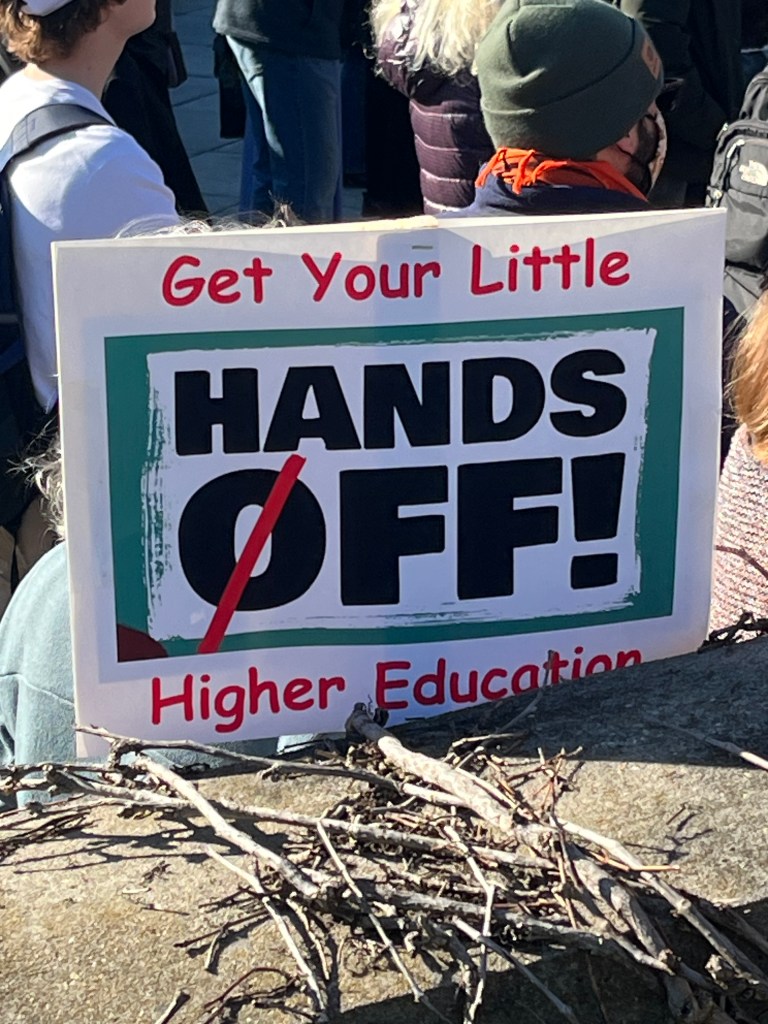
This demonstration is a call to arms for the defense of higher education.
We are calling on Cornell to STAND UP AND FIGHT BACK, because higher education is worth defending.
There are a lot of false narratives circulating these days about higher education.
People say our students are either privileged puffballs or left-wing lunatics.
People say that faculty are either cocooned in ivory towers where they are completely untethered to the day-to-day concerns of ordinary folks, or they are scheming to indoctrinate our students in dangerous and subversive ideologies.
And recently, people have been saying that universities are hotbeds of anti-semitism.
These are all false narratives, and those who promote them are profoundly ignorant of who we are, what we do, and how we do it.
Let’s start with the students. Our 26,000 students are incredibly diverse. They don’t come to us as empty vessels waiting for us to pour our ideological perspectives into their waiting brains. They are smart and they know how to think for themselves. Many of them have experienced economic precarity, others have undergone tremendous hardships, and yes, some come from more elite backgrounds. But whatever their backgrounds, the vast majority are thoughtful and eager to learn.
Cornell’s best students are also deeply principled and empathetic. They care about the world we live in. They care about the suffering of people in Darfur, in Ukraine, in Xinjiang China, and in Gaza. And when they speak out about injustice, and when they make us uncomfortable with their demands, they are doing precisely what students have done for generations.
Our student protestors are human rights defenders who deserve our protection and support under international human rights law. The UN expert on the Rights of Freedom of Peaceful Assembly and of Association wrote recently that the university Palestinian solidarity protest movement demonstrated “the profound sensibility, civic responsibility, and creative potential of youth.” And the UN expert on human rights defenders has pointed out that youth and children “are at the forefront, and often the main driving force, of societal, economic and political change.” We must forcefully resist the false narrative that student protestors are criminals or terrorists—and University leadership must likewise resist the pressure to subject them to ever-more severe disciplinary measures that jeopardize their safety and their futures.
As for our faculty – let’s talk about some of the life-saving, transformative work that we’re doing in communities in New York, around the United States, and throughout the world. Many of our faculty may lose their jobs under the government’s threatened funding freeze.
At the Cornell Medical School, the faculty who are most vulnerable to job cuts carry out life changing medical research, take care of you and your families when you are sick, and educate future generations of researchers and doctors so that someone will be around to take care of your children and grandchildren.
At Cornell Law School, the most vulnerable faculty are those who, together with law students, are helping low-income taxpayers in rural Alaska fill out their tax returns so they can receive government refunds, or those who are training students to obtain justice for women in the military who are sexual assault survivors. The most vulnerable faculty at the Cornell School of Agriculture and Life Sciences are involved in educating small farmers in Central New York about how they can mitigate the impact of climate change and grow crops that supply regional food systems.
These are just a few examples of what we call RTE faculty – faculty who lack tenure, who work on short-term contracts with little job protection. There are over 1,300 of us working across Cornell. Our work is more vital than ever as government programs are cut and communities lose access to resources. But without job security, we—together with the staff who keep many University programs running—will be the first casualties of federal funding cuts. We need greater pathways to tenure and more job security—and for that, we need the support of our tenured colleagues and the administration. This is a moment where we should stand together to strengthen our institution, not weaken it.
When we stand together, we are STRONG.
When we read about “Cornell University” in the news, those stories are often referring to the actions of our President and Cornell’s Board of Trustees. But they are not Cornell. We who are standing here today are Cornell.
Our librarians ARE CORNELL.
Our staff ARE CORNELL.
Our faculty ARE CORNELL.
Our extension workers ARE CORNELL.
Our students ARE CORNELL.
And we want the Board of Trustees and the President to HEAR OUR VOICE. We are Cornell, and we will not be silenced.
Sandra Babcock is Clinical Professor of Law, specializing in international human rights litigation, access to justice, death penalty defense, international gender rights, and the application of international law in US courts.
 Cornell Chapter of the AAUP