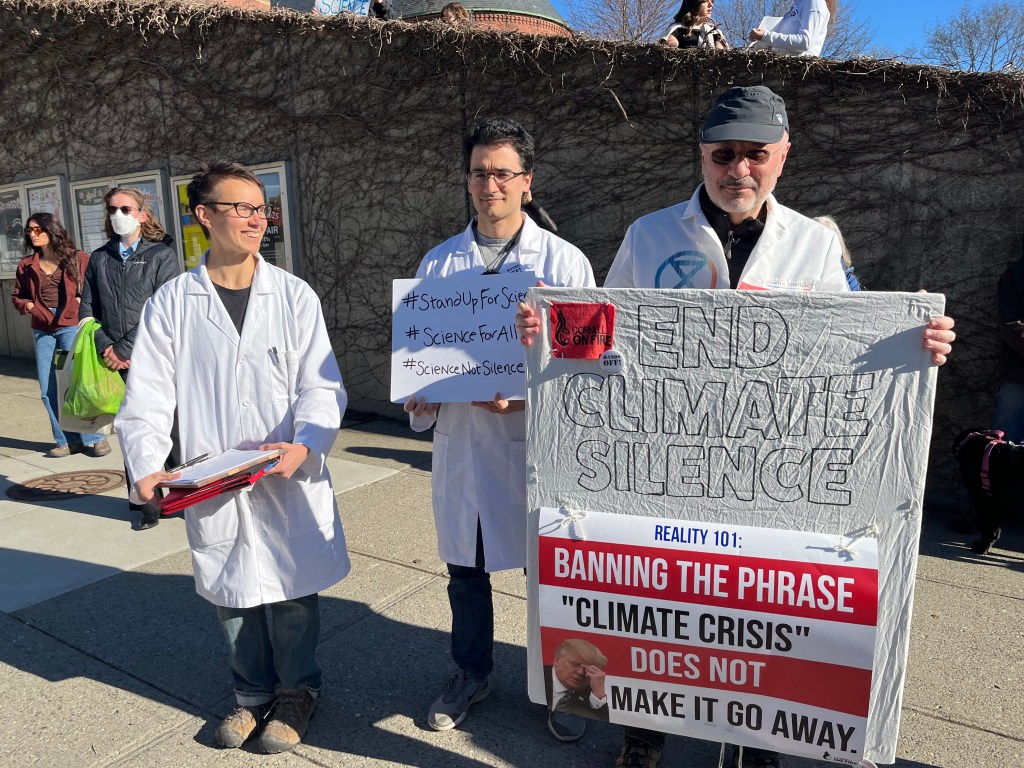
The April 17 National Day of Action had a great turnout at Cornell. We had speakers from across the university, in the sciences, humanities and social sciences, and the law school. We reprint some of these here.
My name is Lara Estroff. I am speaking to you today as a Materials Science and Engineering Professor.
For longer than any of us has been a student or a faculty member, there has been a thriving partnership between American universities and the United States government, committed to educating and training generations of scientists and engineers who have gone on to impactful careers that have made America a healthier, safer, and more technologically advanced society. This partnership has led to innovations that have resulted in faster, more compact consumer electronics, safer airplanes, life-saving vaccines, and more sustainable energy production.
This educational ecosystem is a shining example on the international stage and we attract students from all over the world who want to come and be trained at American universities.
Today, this partnership is threatened because one of the partners, the United States government, is threatening to withdraw. Disruption to this partnership will hurt not only current students and faculty at this and many other great universities, but it also threatens to damage our future as a country.
Now, I want to help us all understand how the money awarded to faculty in grants and contracts from federal funding agencies is actually used. The budgets for these grants have roughly three parts to them: funds to cover the educational costs for our graduate students; the materials and supplies associated with doing this cutting-edge research; and the indirect costs, called “facilities and administrative” or F&A costs, that go to the university.
These F&A costs are what we’ve heard about both in the news and in the emails from President Kotlikof and Provost Bala in regard to recent illegal actions taken by both the National Institutes of Health and the Department of Energy aimed at significantly reducing the F&A rate we can include in our budgets. Cornell has played an essential role in helping to halt both of these actions from being implemented through court-ordered injunctions, but the fight is not over!
At the end of World War II, when the partnership between universities and the government was forged, there was a realization that universities, as engines of innovation, were the ideal place to be training the scientists and engineers the US needed to have scientific and technological leadership in the world. But in order to do so, the infrastructure at these universities would need to be expanded to enable and support fundamental scientific and engineering research.
These may not be “sexy things” but they are incredibly important for doing our work: like laboratories with fume hoods and biosafety equipment, libraries with up-to-date and well-curated collections, cleanrooms for microelectronics fabrication like CNF, chemical and biological waste handling and disposal facilities, and state-of-the-art characterization facilities like CHESS. This infrastructure is expensive to develop and maintain; we’re talking about utility bills and technicians to service the equipment. We’re also talking about the administration costs related to ensuring research integrity and ethical performance of studies involving animals and humans, and much more. All of these costs are substantial and necessary; and require a continuous, rather than a one time, investment.
Without these funds coming into the university, our very mission is threatened. We will be unable to train the next generation of scientists and engineers who are going to be at the forefront of discovery in the coming decades; we will be unable to perform the fundamental research that will lead to innovative new therapies for disease, cleaner drinking water, and more sustainable construction materials for our built environment.
My colleagues and I are speaking with one voice. Some of us identify as Republicans, some as Independents, some as Democrats but we ALL recognize that standing up to the Trump administration is going to come with very real economic impact on our labs and our students. We are ready to take on these sacrifices to ensure that our academic freedoms, our ability to hire faculty and admit students according to our values and our educational mission, is not taken away and put under government oversight as we might expect from some other countries but NEVER in the United States of America! Cornell’s founding principal of “any person, any study” has endured and been a guiding light for 170 years. It is worth far more than $1 Billion. It will not be extinguished on our watch.
We are ready to fight and we are ready to make these sacrifices, but we need to do this together.
Lara Estroff is Chair of the Department of Materials Science and Engineering and Herbert Fisk Johnson Professor of Industrial Chemistry
 Cornell Chapter of the AAUP